Cyber Security for Beginners: 7 Essential Skills (2026)Cyber Security for Beginners: 7 Essential Skills to Learn in 2026 - Solitaire Infosystems
Request a Quote !

Request a Quote !

Request a Quote !

Blogs

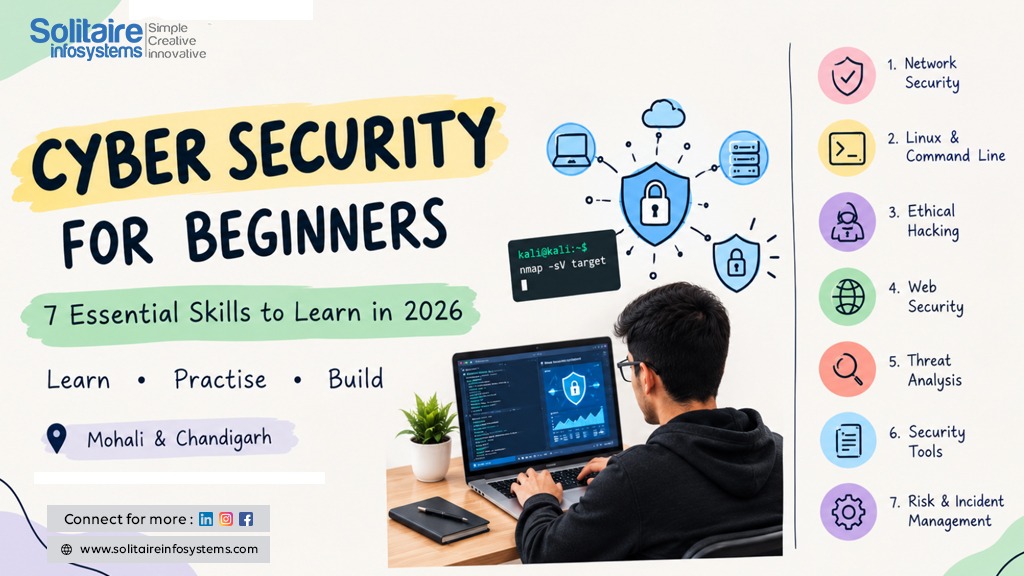
Cyber Security for Beginners: 7 Essential Skills to Learn in 2026

  • By: admin
  • date: Oct 1, 2026
Blog Image

Every website, mobile app, bank account and business network need protection. That is why cyber security skills for beginners are now among the most useful technical skills a student or fresher can build — whether you are in BCA, B.Tech, MCA, B.Sc IT or have just completed Class 12.

For a beginner, cyber security can look huge. It covers networking, operating systems, web security, authentication, ethical hacking, security tools and much more. The good news: you do not need to learn everything at once.

This guide breaks the field into 7 cyber security essentials — the core areas every beginner should understand first — with practical ways to practice each one safely. It is written for students and freshers in Mohali, Chandigarh and across the Tricity, but the roadmap works for anyone starting out.


Why Are Cyber Security Fundamentals Important?

Cyber security is not just about installing antivirus software or running testing tools. It is about understanding how systems work, where risks appear and how those risks are reduced. A strong foundation helps you:

  • Understand how computers, servers and networks communicate.
  • Recognize common threats such as phishing, malware and weak passwords.
  • Understand how access, permissions and authentication work.
  • Apply basic network protection and safer computing habits.
  • Move confidently into advanced areas like ethical hacking, VAPT, SOC operations and cloud security.
  • Connect theory with practical, authorized lab exercises.

At the beginner stage, the goal is simple: understand the concept first, then practice it in a safe, authorized environment.


7 Essential Cyber Security Skills for Beginners

Computer Networking Fundamentals

Networking is the foundation of cyber security. Before you can protect a network, you need to know how devices talk to each other. Key topics to learn:

  • IP addressing and subnetting
  • DNS and how domain names resolve
  • TCP vs UDP
  • Ports and common services
  • The OSI and TCP/IP models
  • Routers, switches and firewalls
  • HTTP vs HTTPS and TLS

For example, when you open a website, your device performs a DNS lookup, opens a TCP connection and negotiates HTTPS encryption before the page even loads. Each of those steps is a place where security controls are applied — or where attacks can happen.

How to practice: Draw simple network diagrams of your home or college network. Later, use a packet analyzer such as Wireshark inside an authorized lab to observe how traffic actually flows.


Linux and Operating System Basics

Most servers, security tools and cloud systems run on Linux, so Linux for cyber security is a must-have skill. Focus on:

  • Files, directories and the Linux file system
  • Users, groups and file permissions
  • Processes and services
  • Command-line basics and shell navigation
  • System logs and where to find them
  • Package management and basic configuration

You do not need to memories hundreds of commands. Understand what each command does and why you would use it.

How to practice: Install Ubuntu or Kali Linux in a virtual machine (VirtualBox or VMware). This gives you a safe space to experiment without affecting your main computer.


Core Security Principles (The CIA Triad)

Once you understand systems and networks, learn the principles behind information security. The most important is the CIA triad:

  • Confidentiality — information is accessible only to authorized people.
  • Integrity — information stays accurate and is not changed without authorization.
  • Availability — systems and data are accessible when legitimate users need them.

Also learn these related concepts, because they appear in every area of cyber security: authentication, authorization, access control, encryption and hashing, threats vs vulnerabilities vs risk, and security policies. Frameworks such as the NIST Cybersecurity Framework show how organizations put these principles into practice.


Web and Application Security

Most of our daily activity — banking, shopping, learning — happens through websites and apps, which makes web application security one of the most in-demand skill areas. Start by understanding how web apps work:

  • HTTP requests and responses
  • Cookies and sessions
  • Login systems and user authentication
  • Forms, APIs and databases

Then study common risks listed in the OWASP Top 10, such as broken access control, injection and security misconfiguration, using intentionally vulnerable practice applications.

Important: Only practice on applications you own, intentionally vulnerable apps built for learning, or systems you have written permission to test.


Python Scripting and Automation

You can start cyber security without being a programmer, but basic Python for cyber security makes you far more effective. Python helps you process log files, work with text and data, automate repetitive tasks, interact with APIs and build small security utilities.

Begin with variables, conditions, loops, functions, lists and dictionaries, and file handling. The goal is not to become a software developer overnight — it is to understand how scripts work and how automation saves time.


Security Tools and Controlled Practice

Cyber security professionals use tools for network scanning, traffic analysis, vulnerability assessment, log monitoring and web testing — for example Nmap, Wireshark and Burp Suite. But beginners should avoid simply memorizing tool commands.

First ask: what problem does this tool solve? A tool may help you examine network traffic, identify potential weaknesses, inspect logs, test an authorized application or understand a security event.

Practical learning should always happen in a controlled, authorized environment. Students who want structured, trainer-guided lab practice can explore the Cyber Security 6 Weeks Industrial Training at Solitaire Infosystems and check the current programme details.


Cyber Security Projects and Problem-Solving

Projects connect everything you have learned — and give you something concrete to show recruiters. They do not need to be advanced:


Beginner Project What You Do Skills You Demonstrate
Network Monitoring Lab Set up a small virtual lab and study basic network communication Networking, packet analysis
Log Analysis Project Use sample logs to spot unusual patterns or login attempts Linux, logs, SOC basics
Security Awareness Guide Create a resource on phishing, passwords and safe browsing Security principles, communication
Web Security Learning Lab Explore an intentionally vulnerable app against the OWASP Top 10 Web application security
System Hardening Checklist Build a checklist for passwords, permissions, updates and backups OS security, best practices


For every project, write down the objective, tools, steps and findings. Documentation is what turns a practice exercise into a portfolio piece.


Cyber Security Roadmap for Beginners (Step-by-Step)

Instead of studying everything at once, follow this stage-by-stage cyber security learning path. Timelines are approximate and depend on how many hours you study each week.


Stage Focus Approx. Time
1. Technology Basics Computer systems, networking, operating systems 3–4 weeks
2. Security Concepts CIA triad, authentication, encryption, threats and vulnerabilities 2–3 weeks
3. Technical Skills Linux command line and basic Python 4–6 weeks
4. Web & Network Security How web and network technologies work and how they are secured 4 weeks
5. Practical Labs Virtual machines, authorized labs, CTF-style exercises Ongoing
6. Projects & Portfolio Build, document and present 3–5 projects 3–4 weeks


How Can Beginners Practice Cyber Security Safely and Legally?

Security knowledge must always be used responsibly. Safe places to practice include virtual machines, your own home lab, intentionally vulnerable applications, educational cyber security labs, Capture-the-Flag (CTF) platforms and authorized college projects.

Never scan or test websites, networks or apps you do not own or have permission to assess. In India, unauthorized access to computer systems is an offence under the Information Technology Act, 2000. Ethical hacking is only ethical when it is authorized.


Common Mistakes Cyber Security Beginners Should Avoid

  • Learning tools without concepts — commands are useless if you do not know what the tool is doing.
  • Skipping networking — it supports nearly every area of cyber security.
  • Trying to learn every domain together — build the foundation before specializing.
  • Practicing on unauthorized systems — always use legal, controlled environments.
  • Copying projects — your portfolio should show your own understanding.
  • Not documenting your work — notes on objective, process and findings make your skills visible.


Cyber Security Career Paths After the Fundamentals

Once your basics are strong, you can move towards a specialization. Common entry-level cyber security job roles include:


Career Path What the Role Involves
SOC Analyst (L1) Monitoring alerts, analyzing logs and escalating security incidents
VAPT / Penetration Tester Authorized testing of apps and networks to find vulnerabilities
Network Security Engineer Configuring firewalls, VPNs and secure network architecture
Web Application Security Analyst Testing and securing websites and APIs
Cloud Security Associate Securing cloud accounts, identities and configurations
GRC / Compliance Analyst Policies, risk assessments and security audits


Many learners later validate their skills with recognized certifications such as CompTIA Security+ or EC-Council’s CEH. Always check current exam requirements on the official certification websites.


Cyber Security Training in Mohali & Chandigarh: Learning with Practical Support

Self-study builds knowledge; structured practical training helps you apply it. If you are a student or fresher in Mohali, Chandigarh, Panchkula, Zirakpur or Kharar, look for a cyber security course that offers:

  • A clear curriculum covering networking, Linux, web security and tools
  • Hands-on lab hours, not only theory
  • Guidance from experienced trainers
  • Real project work you can add to your resume
  • A certificate and flexible batch timings for college students

Solitaire Infosystems in Mohali offers practical, lab-based Cyber Security Training for students and freshers across the Chandigarh Tricity. Review the current curriculum, duration and practical components to see if it fits your goals.


Building Experience Through Projects and Internships

A documented project gives you something real to talk about in interviews. Instead of just writing “Cyber Security” on your resume, you can describe a project involving network analysis, Linux administration, log analysis, security awareness or authorized web-security testing.

Students who want industry exposure can also explore the Cybersecurity Internship in Chandigarh and check current eligibility and programme details.

An internship or training programme does not automatically guarantee a job, but practical experience gives you relevant examples to discuss with employers.


Frequently Asked Questions (FAQs)


What should a beginner learn first in cyber security?

Start with computer networking, operating systems (especially Linux) and core security principles like the CIA triad. These fundamentals make advanced topics such as ethical hacking and web security much easier to understand.


Can I learn cyber security without a coding background?

Yes. You can begin without programming knowledge. Basic Python can be learned gradually and later helps with automation, log analysis and building small security tools.


Is Linux necessary for cyber security?

Linux is not the only operating system used, but it is strongly recommended because most servers and security tools run on Linux. Learning the command line, permissions and logs is very useful.


How long does it take to learn cyber security basics?

Most beginners can build a solid foundation in about 4 to 6 months with regular study and lab practice. The exact time depends on your background and weekly study hours.


Which cyber security projects are good for beginners?

Good beginner projects include a network monitoring lab, log analysis, a security awareness guide, a web security learning lab using an intentionally vulnerable app, and a system hardening checklist.


Can I practice cyber security at home?

Yes. Virtual machines, home labs, CTF platforms and intentionally vulnerable applications let you practice safely and legally at home.


Should beginners start with ethical hacking?

Ethical hacking is one part of cyber security. It is better to learn networking, operating systems and security fundamentals first, then move into authorized security testing.


Is a 6-week cyber security training useful for students?

A 6-week industrial training can give students structured lab exposure and a guided project, especially during semester breaks. It works best when combined with continued self-practice.


Where can I learn cyber security in Mohali or Chandigarh?

Students in the Chandigarh Tricity can explore practical cyber security training and internship programmes at Solitaire Infosystems in Mohali. Compare curriculum, lab hours, projects and batch timings before choosing any course.


Who can join a cyber security course?

Students and graduates from BCA, MCA, B.Tech, B.Sc IT, diploma programmes and Class 12 pass-outs with an interest in technology can start with a beginner-level cyber security course.


Conclusion

Cyber security is a broad field, but you do not have to learn it all at once. Build your skills step by step: networking, Linux, security principles, web security, Python scripting, security tools and hands-on projects.

Focus on understanding how systems work, identify risks responsibly and document what you learn. Combine fundamentals, authorized lab practice and real project work, and you will have a strong foundation for a career in cyber security.

About the Author

Comments