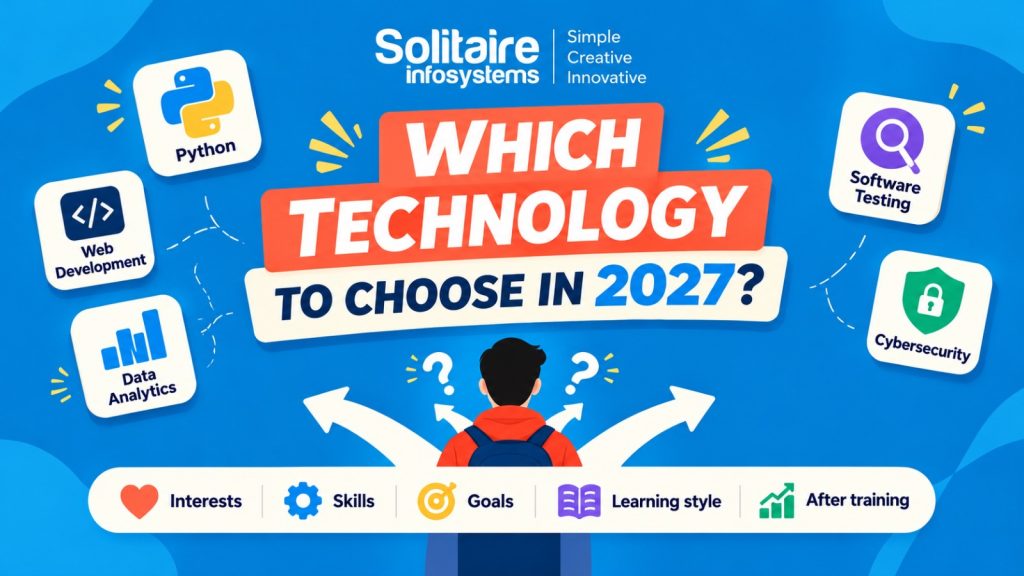
Which Technology to Choose for 6 Months Training in 2027?
Request a Quote !

Request a Quote !

Request a Quote !

Blogs

Which Technology to Choose for 6 Months Training in 2027? Ask Yourself These 5 Questions

  • By: admin
  • date: Oct 26, 2026
Blog Image

Pick the technology whose everyday work you would happily practise for six months, not the one with the loudest hype. If you are stuck on which technology to choose for 6 months training in 2027, five questions about yourself will narrow it down faster than any “top trending courses” list: what work you enjoy, what you already know, what you want to build, how you learn, and what you need once training ends.

Most B.Tech, BCA, MCA and diploma students face this decision in their final year, usually with a few weeks to decide and plenty of conflicting advice. A friend picks web development. A senior swears by data analytics. YouTube says everything is AI now. Any of these can be a good choice. None of them is automatically the right one for you.

Six months is enough to learn one field properly and finish a real project. It is not enough to learn three. That is why the choice deserves an hour of honest thinking.


Question 1: What kind of work do you actually enjoy?

Every IT field looks different on a normal Tuesday afternoon. Here is what the day-to-day work feels like in five common options.


You like making things people can see and click: web development

If arranging layouts, styling buttons and making a page respond to clicks sounds fun, start with web development. The usual order is HTML, CSS and JavaScript, then a front-end framework such as React, or back-end work later.

First project: a personal portfolio site or a simple task manager.


You like logic puzzles and breaking problems into steps: Python

Python programming suits people who enjoy working out how to solve something. You begin with variables, conditions, loops, functions and lists, and later use Python for automation, scripting or data work.

First project: an expense tracker or a script that sorts the files in a messy folder.


You like numbers, patterns and explaining what they mean: data analytics

Data analytics is less about coding all day and more about asking good questions of data. Expect spreadsheets, SQL and a visualization tool such as Power BI or Tableau, depending on the syllabus.

First project: analyze a sample sales dataset and present three clear findings in a dashboard.


You notice what is broken before anyone else: software testing

If you are the person who spots the typo on the menu card, software testing may fit. You learn to write test cases, run functional tests and report bugs clearly enough that a developer can fix them.

First project: test a sample website and write a proper bug report sheet.


You want to know how systems get attacked and protected: cybersecurity

Cybersecurity basics cover networking, operating systems, common threats and how access is controlled. It rewards patience, because you need networking fundamentals before the interesting parts make sense.

First project: a permission-based lab exercise, such as securing a test machine and documenting what you changed and why.

Quick test before you decide: spend one evening on a free beginner exercise in two of these fields, for example the MDN Learn web development guide or the official Python tutorial. The one you keep doing after the hour is up is telling you something.


Question 2: What do you already know?

Be honest here. Nobody expects you to be an expert before training, but your starting point decides which course level makes sense.

  • Have you written any code before, even in college labs?
  • Are you comfortable with spreadsheets or databases?
  • Do loops, conditions and functions make sense to you?
  • Are you willing to spend the first month on basics, even if they feel slow?

If most answers are “no”, choose a course that teaches fundamentals properly and gives you daily practice. If you already know basic HTML and CSS, you can move to JavaScript sooner. If you have used Python in college, you can head towards automation or data work earlier.

One mistake trainers see every batch: students pick an advanced course so they don’t look like beginners, then struggle for months because the foundations were never in place. Starting at the right level is faster in the end.


Question 3: What do you want to show at the end of six months?

Picture the last week of training. Someone asks, “What did you build?” Your answer points to a technology.

If you want to… Explore A realistic beginner project
Build websites and interactive pages Web development Portfolio site or task manager
Write programs that solve everyday problems Python programming File organiser or expense tracker
Understand data and explain findings Data analytics Sales dashboard from sample data
Find and document software issues Software testing Test-case sheet and bug report
Understand how systems are secured Cybersecurity fundamentals Permission-based security lab


Treat this as a starting map, not a career prescription. Your final project should match your level and the syllabus you actually get.


Question 4: How do you learn best?

The same course can feel easy or impossible depending on how it is taught. Which of these sounds like you?

  • You learn by building. Look for programs with daily coding tasks and a guided project, not mostly theory.
  • You learn by analysing. Data-heavy paths with real datasets and case-style exercises will keep you interested.
  • You learn by checking step by step. Testing and quality-focused training suits a methodical mind.
  • You learn from clear explanations first. Prioritise small batches, live demonstrations and a trainer you can actually ask questions.

Before enrolling, ask three things: how many hours are hands-on practice, how feedback is given, and what you are expected to complete by the end.


Question 5: What do you need once training ends?

Write down one main goal and two supporting goals. Keep them specific enough to check.

Main goal: build a solid foundation in web development.

  • Learn the core concepts and tools in the syllabus.
  • Finish one working website project.
  • Be able to explain every decision in that project in an interview.

“Become good at IT” can’t be measured. “Finish a tested project and explain it confidently” can. If you are still working out how industrial training fits into your degree, this industrial training guide for students explains the basics.


How do you turn your answers into one choice?

Lay your five answers side by side and look for the pattern:

  • Enjoy building interfaces + know some HTML + want a website to show = web development.
  • Enjoy logic + want to automate tasks + learn by coding = Python.
  • Enjoy patterns + want to present findings = data analytics.
  • Enjoy catching errors + like structured processes = software testing.
  • Curious about networks and threats + patient with fundamentals = cybersecurity.

Then shortlist two or three programs and compare them on these points:

  • Does the syllabus start at your current level?
  • How much of the time is practical work?
  • Is there a real project you will build yourself?
  • Can you get help from a trainer when you are stuck?
  • Are fees, timings, attendance rules and completion requirements written down clearly?

Read the actual syllabus, not just the course title. Two courses called “Full Stack Development” can teach very different things.

If you are comparing options in the Tricity, Solitaire Infosystems runs 6 months industrial training and internship programs from its office in Phase 7, Industrial Area, Mohali. Ask for the current syllabus of the technology you shortlisted and check it against your five answers.


Is 6 months enough to learn a technology?

Yes, for the fundamentals and one or two solid projects, if you practice most days. No, if you expect to become an expert or cover several unrelated technologies. A realistic plan looks like this:

Months Focus What you should have by the end
1–2 Fundamentals and core tools Small exercises done without copying; a list of weak topics to revise
3–4 Build your main project A working first version with the core features
5 Test, fix and improve Common errors handled; trainer feedback applied
6 Review and present A clear explanation of your project, tools used and problems solved


Your institute’s schedule comes first. Use this as a way to check whether you are on track.

What mistakes should you avoid when choosing technology for 2027?

  • Following the trend, not your interest. Popular does not mean right for you.
  • Signing up for three technologies at once. You end up with surface knowledge of all and depth in none.
  • Ignoring the syllabus. The course title rarely tells you the tools or the project.
  • Skipping the one-evening test. A short beginner exercise can save you six months in the wrong field.
  • Believing job guarantees. Training builds skills; hiring still depends on what you can show and explain.


Frequently Asked Questions


Which technology should I choose for 6 months training in 2027?

Pick the field whose everyday work you enjoy and can practice for six months: web development if you like building pages, Python if you like logic, data analytics if you like numbers, software testing if you like catching errors, or cybersecurity if you like understanding how systems are protected. Then compare the actual syllabus of two or three programs before you enroll.


Is 6 months enough to learn a technology?

Six months is enough to learn the fundamentals of one technology and complete one or two working projects, if you practice regularly. It is not enough to become an expert, and it is rarely enough to learn several unrelated technologies well.


Should I learn Python or web development first?

Choose web development if you want to see visual results quickly and enjoy design and interaction. Choose Python if you prefer solving logic problems, automating tasks or moving towards data work later. Spend an evening on a beginner exercise in each before you decide.


Does 6 months training guarantee a job?

No training can honestly guarantee a job. It builds skills and gives you a project to show, but hiring depends on employer requirements, how well you can explain your work, and the interview process.


Can I change my technology after starting training?

Sometimes, but it depends on your institute and how much time is left. If the first few weeks show the field is a poor fit, talk to your trainer early rather than waiting until month four.


Ready to shortlist your technology?

Start with yourself, not the trend. Answer the five questions, try a beginner exercise in your top two fields, and then compare real syllabuses. The right technology is the one you will still be practicing in month five.

Next step: check the details of 6 months industrial training and internship in Mohali and Chandigarh at Solitaire Infosystems, including the January 2027 batch, and ask for the syllabus of the technology you chose.


About the Author

Comments