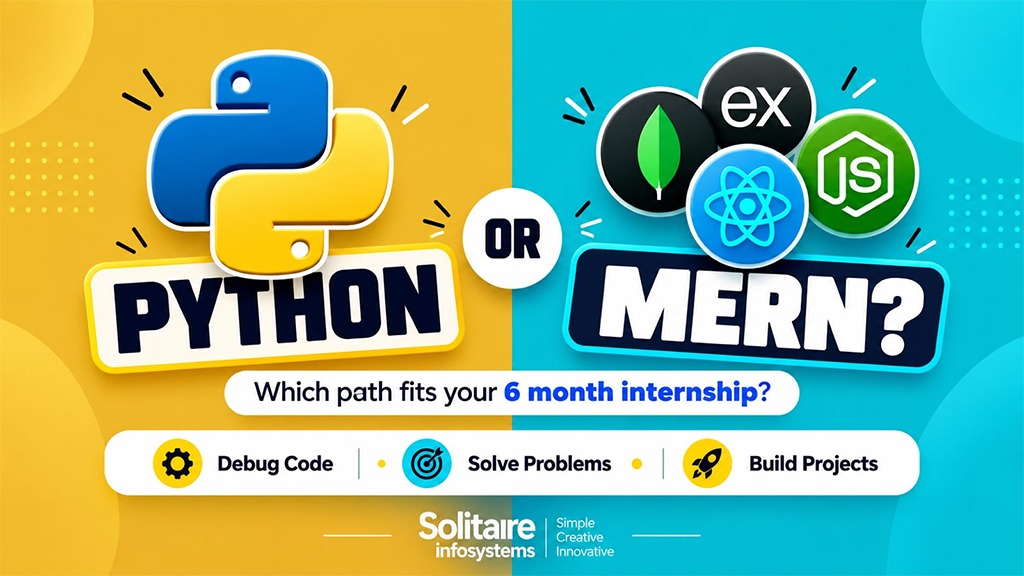
Python or MERN for a 6 Month Internship? How to Choose
Request a Quote !

Request a Quote !

Request a Quote !

Blogs

Python or MERN for a 6 Month Internship? Pick by the Bugs You Enjoy Fixing

  • By: admin
  • date: Oct 27, 2026
Blog Image

Deciding between Python or MERN for a 6 month internship comes down to one question: what kind of problem do you want to spend six months fixing? Choose Python if you like logic, data and automation, where the typical bug is a script that breaks on messy input. Choose MERN if you like seeing how a website’s screen, server and database work together, and figuring out why they stopped talking to each other.

Python is a general-purpose programming language used for automation, data processing, scripting and back-end development. MERN Stack is a set of four JavaScript technologies (MongoDB, Express.js, React and Node.js) used to build full-stack web applications.

Both are sensible choices for a first internship. The real difference is the kind of debugging you will do every day, and whether it keeps you curious or wears you down. Below you’ll find what each path looks like in practice, two short tests you can try tonight, project ideas, and a month-by-month plan.


Python vs MERN at a Glance

Python MERN Stack
What you build Scripts, automation tools, data tools, back-end programs Interactive, database-backed web applications
Typical bug Wrong output or a crash caused by bad input or broken logic Data not showing on screen because a request, route or query failed
Where you debug Traceback, print/log statements, the data itself Browser console, Network tab, server logs, the database
Language Python only JavaScript across front end and back end
End-of-internship project A working tool or data project you can demo A live web app with screens, API and database


This isn’t a strict split. Python is also used for web development (with frameworks like Django or Flask), and MERN work still needs solid logic. Treat the table as a starting point, not a rule.


Which Kind of Debugging Do You Actually Enjoy?

Read both situations below and notice which one you’d rather sit with for an hour.


Situation A: The script works, until the data doesn’t

You write a script that processes 500 records. It runs fine on your sample file, then crashes on the real one because a single row has an empty value. You read the error, find the row, and decide how the program should handle it next time.


Situation B: The page loads, but the data never shows up

You build a React page that fetches tasks from your server. The page loads, there’s no error on screen, and the list is empty. You open the browser console, check the network request, look at the server response and query the database to work out which layer is at fault.

If Situation A sounds satisfying, lean towards Python. If B makes you want to open DevTools right now, lean towards MERN. Neither is easier. What matters is which problem you’ll keep chasing instead of giving up on.


What Does a Python Internship Involve?

Most structured Python programmes start with fundamentals and move towards practical work. The exact sequence depends on the syllabus, but you can expect to practice:

  • Variables, data types, conditions, loops and functions
  • Lists, dictionaries and other data structures
  • File handling and exception handling
  • Organizing code into reusable functions and modules
  • Working with data, files or APIs, depending on the programme
  • Testing and debugging your own programs


Example: fixing an expense tracker

Say your expense tracker reads transactions from a CSV file and crashes on one row with a missing amount. A beginner changes random lines until the error goes away. A better approach:

  1. Reproduce the crash using only the problem row.
  2. Read the traceback to find the exact line that fails.
  3. Check what the input looks like at that point.
  4. Add validation so bad rows are handled instead of crashing the program.
  5. Test again with valid, missing and wrongly formatted values.


Mistakes Python beginners often make

  • Wrapping everything in a bare except:, which hides the real error instead of handling it.
  • Testing only with clean sample data and never with empty or badly formatted input.
  • Writing one long script instead of small functions that can be tested separately.

Python suits you if you want to build strong programming logic first and specialize later, in automation, data work or back-end development. The official Python tutorial is a good free place to test whether you enjoy the basics before you commit.


What Does a MERN Stack Internship Involve?

MERN combines four tools that each handle one layer of a web application:

  • MongoDB: the database that stores your application’s data
  • js: a framework for building server routes and APIs
  • React: a library for building interactive user interfaces
  • js: the runtime that lets JavaScript run on the server


A MERN learning path is mostly about understanding how these layers connect. Expect to practice:

  • JavaScript fundamentals, including async/await and promises
  • React components, state and user interactions
  • Building REST API routes with Express
  • Sending requests from the front end and handling responses
  • Storing and retrieving data in MongoDB
  • Testing full user flows and debugging integration issues


Example: the task that saves but never appears

Your task manager lets a user add a task. You click “Add”, nothing breaks, and the list stays the same. To trace it:

  1. Check that the form is collecting the right values.
  2. Open the Network tab and inspect the request being sent.
  3. Read the server’s response and status code.
  4. Confirm the Express route receives the data (is body empty?).
  5. Check MongoDB to see whether the task was actually saved.
  6. Check that React updates its state after the request succeeds.

Very often the task is saved in the database correctly, and the only bug is that the front end never refreshed its list. Learning to find which layer is responsible is the core MERN skill.


Mistakes MERN beginners often make

  • Forgetting json() middleware, so req.body arrives empty.
  • Not awaiting async calls, so code runs before the data comes back.
  • Assuming a blank screen is a React problem without checking the API response first.

MERN suits you if you want to build complete web applications and understand everything from the button a user clicks to the record in the database. The official React learning guide is a good way to test the front-end side first.


Try a 30-Minute Test Before You Decide

Reading comparisons only gets you so far. Try one small exercise for each and pay attention to how it feels.


Python test

Write a program that takes two numbers and divides the first by the second. Enter zero as the second number. Read the error, then change the program so it shows a clear message instead of crashing.


MERN test

Build a simple React page with a button that loads a list of tasks from a local JSON file or a basic API. Then break the request on purpose (use a wrong URL) and make the page show an error message instead of a blank screen.

After each one, ask yourself: Did I understand what went wrong? Did I enjoy tracking it down? Would I happily do this again tomorrow? Your honest answers are a better guide than any salary table.


What Can You Build During a 6 Month Internship?

One well-built project you can explain is worth more than five half-finished ones. Pick a single idea that matches your level and add features gradually.

Python project ideas

  • Expense tracker: store transactions, calculate totals, group by category and generate a monthly summary.
  • File organiser: sort files into folders by type, date or another clear rule.
  • Data analysis tool: clean a sample dataset, handle missing values and present a few useful findings.
  • Task reminder app: store tasks, track completion and show what is due.

MERN Stack project ideas

  • Student task manager: add tasks, update status and sort by deadline.
  • Inventory app: store products, update quantities and search records.
  • Course management portal: display courses and manage sample records through an admin view.
  • Appointment booking app: let users pick an available slot and save the booking, with validation to stop double bookings.

Whatever you choose, document what you personally built. In interviews, “I fixed this specific bug, and here’s how” lands far better than a feature list.


How Should You Plan the Six Months?

Here’s a simple framework. Your programme’s syllabus may follow a different order, but the principle of fundamentals first, then building, then refining stays the same.


Month Python focus MERN focus
1–2 Fundamentals, functions, data structures, error handling JavaScript fundamentals, then React basics
3 Start a small working project Add Express routes and MongoDB; start a small app
4 Validation, debugging, cleaner code structure Connect front end to API; debug the full flow
5 Test with real and messy inputs; improve features Test user flows, handle errors, polish the UI
6 Clean up code, write documentation, prepare a demo Clean up code, write documentation, prepare a demo


Ask for feedback at every stage. Code that a mentor has reviewed teaches you more than code that only you have seen.


How to Choose the Right 6 Month Internship Programme

Don’t pick a programme by its title alone. Before enrolling, ask:

  • Which concepts and tools are actually covered in the syllabus?
  • Does it start at my current level?
  • Will I build a real project, or only do exercises?
  • How and how often will I get feedback on my code?
  • Will I learn testing and debugging, or only writing new code?
  • What are the duration, timings, fees and completion requirements?
  • Will I present or demo my project at the end?

Solitaire Infosystems, an IT training and internship company in Mohali, runs both paths. If Python feels right, review the Python 6 months industrial training and compare its topics with your goals. If MERN appeals more, see the MERN Stack development internship in Mohali for its technology coverage and project approach. Programme details and batch schedules change, so confirm the current syllabus directly before you decide.


Frequently Asked Questions


Is Python or MERN better for a 6 month internship?

Neither is better for everyone. Python suits students who enjoy programming logic, automation or data work. MERN suits students who want to build full-stack web applications. Choose based on the problems you enjoy solving and the programme’s practical content.


Which is easier for a complete beginner, Python or MERN?

Python is usually easier to start with because its syntax is simple and you learn one language. MERN asks you to understand JavaScript plus four connected tools, so the first few weeks feel heavier, but you see visible results in the browser quickly.


Can a beginner learn Python in six months?

Yes, a beginner can build a solid Python foundation and complete a small project in six months with regular practice. How far you get depends on your starting point, daily practice time and the depth of the syllabus.


Do I need to know JavaScript before a MERN internship?

Basic JavaScript helps a lot, because every part of MERN uses it. Check whether the programme teaches JavaScript fundamentals before moving to React, Node.js, Express and MongoDB.


Is a 6 month internship in Python or MERN worth it?

It is worth it if the programme includes real project work, code feedback and debugging practice. Six months gives you enough time to go beyond tutorials and build something you can explain in an interview.


Can I switch from Python to MERN later?

Yes. Logical thinking, debugging and understanding requirements carry over between technologies. You will still need to learn JavaScript, React and the MERN workflow, but you won’t be starting from zero.


Still Deciding? Start With the Problem, Not the Name

If tracing logic, cleaning data and automating tasks sounds like a good day, go with Python. If you want to understand how a web app connects its screen, server and database, go with MERN. Try both 30-minute tests, compare real syllabuses, and pick the path that keeps you curious.

For broader preparation tips, read our internship guide for students and freshers, or explore all industrial training and internship options in Mohali.

Ready to choose? Compare the Python industrial training and the MERN Stack internship, or visit Solitaire Infosystems at C-110, Phase 7, Industrial Area, Mohali to talk through which path fits you.

About the Author

Comments