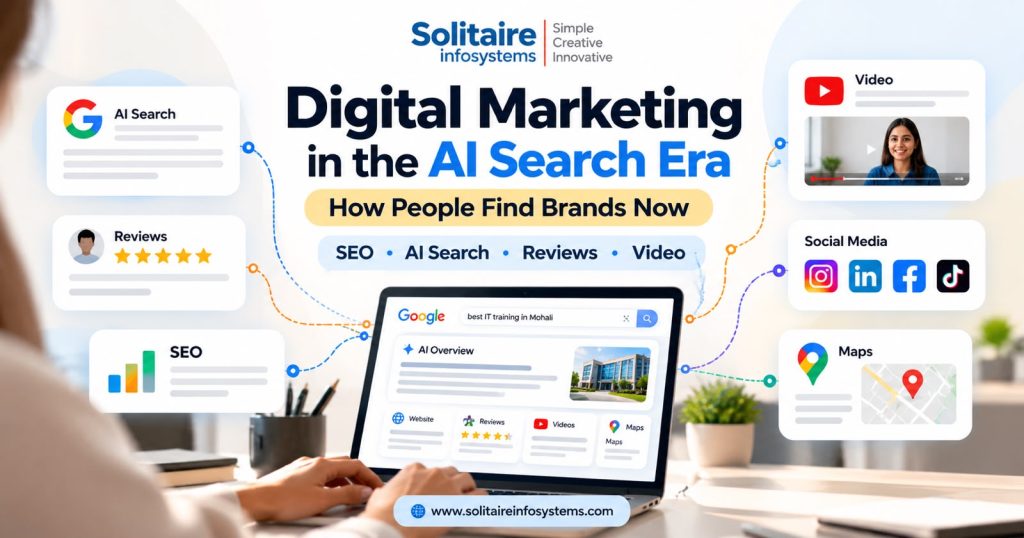
Digital Marketing in the AI Search Era: How Brands Get Found
Request a Quote !

Request a Quote !

Request a Quote !

Blogs

Digital Marketing in the AI Search Era: How People Actually Find Brands Now

  • By: admin
  • date: Oct 28, 2026
Blog Image

Think about the last time you chose a course, a phone or a place to eat. You probably didn’t run one Google search and click the first link. You searched, skimmed an AI summary, read a few reviews, maybe watched a video, and only then made up your mind. That messy, multi-step journey is how most people find brands now. It’s also why digital marketing in the AI search era looks different from what it did a few years ago.

The basics haven’t gone anywhere. Good SEO, clear content and a well-kept business profile still do most of the heavy lifting. What has changed is where people first meet a brand, and how little time that brand gets to make sense to them.

If you’re learning digital marketing, this is worth understanding properly. It shapes what clients and employers will expect you to know.


Where people discover brands today

Discovery is now spread across four or five places, and most people move between them without thinking about it.


Google results and AI Overviews

Google is still where a lot of searches start. The difference is that many queries now show an AI Overview at the top: a short generated answer with links to the pages it drew from.

That changes the job slightly. Ranking still matters, but so does having a page that answers the question cleanly enough to be cited. A long post that circles a topic for 1,500 words is less useful here than a page that states the answer plainly and then explains it.

One point that gets lost in the hype: Google’s own documentation says there are no additional requirements to appear in AI Overviews or AI Mode. The same SEO fundamentals apply.


AI assistants like ChatGPT, Gemini and Perplexity

People now type full questions into AI tools. Not “digital marketing”, but “I’m a BCom student, which digital marketing skills should I learn first to get an internship?”

Those questions are longer and far more specific than a typical search. Some tools show the sources behind their answers and some don’t. Either way, what they say draws on what’s published online: your website, your business listings, reviews and articles that mention you.

So if your own site is thin, outdated or contradicts your Google Business Profile, you’re leaving other sources to describe your brand for you.


YouTube, Instagram and short video

A lot of discovery happens before someone even knows they need you. A student scrolling Reels sees a 40-second clip explaining the difference between SEO and paid ads, follows the account, and a few weeks later searches for the institute by name.

That’s why educational video usually beats promotional video. Show how something works. Answer the question people are too shy to ask in class. Brand recall comes as a side effect.


Reviews and Google Business Profile

For anything local, reviews and the business profile are often the deciding step. Someone searching for digital marketing training in Mohali will look at the map results, read a handful of reviews, check the photos and see whether the location and timings work for them.

An incomplete profile with old photos and unanswered reviews quietly loses those people. Keeping it accurate, posting updates and replying to reviews (especially the critical ones) is unglamorous work, but it’s some of the most direct local SEO there is.


Is SEO still worth learning if AI is answering the questions?


Yes. AI search hasn’t replaced SEO. It has made lazy SEO less forgiving.

AI features still depend on pages being crawled, indexed and understood. What has faded is the shortcut version of SEO: repeating a keyword fifteen times, publishing five near-identical posts, chasing word counts. The parts that hold up are the ones that were always the real work.

  • Search intent. “What is SEO” wants an explanation. “SEO course in Mohali” wants a course page with duration, fees and location. Writing the wrong kind of page for a query is one of the most common beginner mistakes.
  • Clear, specific content. Answer the question early, then go deeper. Use headings that match how people phrase their questions, and use examples from real work rather than broad statements.
  • Sensible structure and internal links. Related pages should link to each other, so a reader (and a crawler) can move from a basic explainer to a detailed guide to the relevant course or service page.
  • Technical health. Mobile usability, page speed, HTTPS, crawlability and indexing. Nobody notices these when they’re right. Everyone notices when they’re wrong.

None of this guarantees a ranking or an AI citation. Nothing does. But it puts a page in the running.


How businesses can improve their AI search visibility


There’s no setting that makes ChatGPT recommend your brand, and anyone promising guaranteed AI rankings is overselling. What you can control is whether accurate, consistent information about your business exists in the places these tools read from.

  1. Say clearly what you do. Your homepage and key service pages should state what you offer, who it’s for and where you’re based, in plain words rather than slogans.
  2. Keep your details consistent. Business name, address, phone number, timings and services should match across your website, Google Business Profile, social profiles and directories. Mismatches confuse people and machines alike.
  3. Answer real questions. Note the questions your counselling or sales team hears every week and answer them on your site. They’re often the exact questions people put to AI tools.
  4. Earn genuine reviews and mentions. Ask satisfied customers for honest reviews, and contribute useful answers in forums, guest articles and local publications. Bought or scripted reviews tend to backfire.
  5. Measure what you can. Google Search Console counts traffic from AI Overviews and AI Mode within its overall Performance report (under the Web search type), so track impressions, clicks and queries there, and use Google Analytics to see what visitors do once they land. It’s also worth simply asking new enquiries how they found you.


What digital marketing students should focus on


If you’re starting out, it’s tempting to jump straight to AI tools. Hold off a little. The tools change every few months; the fundamentals underneath them don’t.

  • SEO: keyword research, on-page optimization, technical basics and link building. Learn to audit a real website, not just define the terms.
  • Content: blog posts, landing pages and FAQs that answer one specific question for one specific reader.
  • Local SEO: setting up and managing a Google Business Profile, handling reviews and keeping listings consistent.
  • Analytics: reading Search Console and Google Analytics, then turning the numbers into a short, honest report.
  • AI tools, used carefully: fine for research, outlines and first drafts. Fact-checking, judgement and the final edit are still your job.
  • Social and video: how short-form content gets discovered, even if you never become a creator yourself.

The fastest way to learn any of this is on real projects: auditing a live site, rewriting a weak page, setting up tracking and watching what changes over a few weeks. Reading about SEO and doing SEO feel very different. If you want structured, hands-on practice, take a look at the digital marketing training at Solitaire Infosystems to see what it covers.


Where this is heading


Search will keep fragmenting. More answers will appear without a click, and more people will ask an AI tool before they ask Google, or alongside it. That makes it tempting to chase every new platform.

A steadier approach works better: be the most accurate, useful source on the topics you genuinely know, keep your business information consistent, and show up where your audience already spends time. Those are the brands that search engines and AI tools find easiest to understand.

AI can speed up research and drafting. It can’t replace knowing your customer, checking facts or having an original point of view. That part is still the marketer’s job.


Frequently Asked Questions


What does digital marketing in the AI search era mean?

It means promoting a brand while accounting for the fact that people now find it through AI answers, Google results, reviews, social media and video, often all within the same decision.


Will AI search replace SEO?

No. Google’s AI features still rely on pages being crawled, indexed and understood, and Google states there are no additional requirements to appear in AI Overviews or AI Mode beyond the usual SEO fundamentals.


Can a business guarantee it will appear in ChatGPT or AI Overviews?

No. Clear, accurate and consistent information plus genuinely helpful content improves the odds, but no business controls what an AI tool includes in its answers.


How can I see traffic from Google’s AI Overviews?

It’s included in the overall Performance report in Google Search Console, under the Web search type, rather than shown as a separate report.


Which digital marketing skills should a beginner learn first?

Start with SEO fundamentals, content writing, Google Business Profile management and analytics. Add AI tools once you can judge whether their output is right.


Learn digital marketing with Solitaire Infosystems

If you want to understand how brands actually get found, and practice it rather than just read about it, explore the Digital Marketing Training at Solitaire Infosystems.

You can also visit Solitaire Infosystems at C-110, Phase 7, Industrial Area, Mohali, to talk through the course, batch timings and whether it fits your goals.


About the Author

Comments