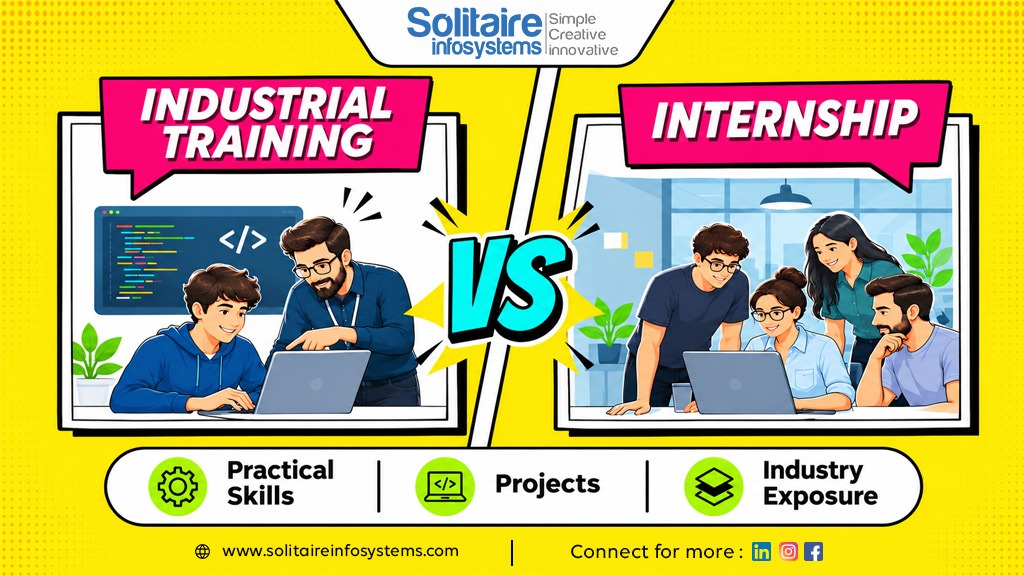
6 Months Industrial Training vs Internship: Key Differences
Request a Quote !

Request a Quote !

Request a Quote !

Blogs

6 Months Industrial Training vs Internship: What’s the Real Difference?

  • By: admin
  • date: Nov 5, 2026
Blog Image

A 6 months internship places you inside a working team, where you learn by doing assigned work. A 6 months industrial training program teaches you a technology step by step and then has you apply it through assignments and projects. When students compare 6 months industrial training vs internship, the deciding factor is rarely which one sounds better. It is which one your college accepts and which skills you are actually missing right now.

In practice, the line between the two is blurry. Plenty of institutes run programs that start with structured training and move into project work, so the name on the certificate matters less than what you do for those six months. Below is how to tell them apart, what each one looks like day to day, and how to choose.


What is a 6 months internship?


A 6 months internship is a full-semester work placement in which a student joins a company team, takes on real tasks and learns on the job under a mentor or team lead.

The key word is contribution. An internship assumes you already know the basics and can be given work. A web development intern, for example, might fix layout bugs on a client’s WordPress site in week one, build a landing page in React by month two, and get code reviews from a senior developer along the way. Nobody stops to teach JavaScript from scratch.

What an internship usually gives you:

  • Experience of real deadlines, client feedback and team workflows
  • Hands-on use of the tools the company actually works with
  • Communication practice: stand-ups, updates, asking for help the right way
  • Work you can describe in interviews as “I did this for a real project”

If you want a broader look at applying, preparing and getting the most from one, read our internship guide for students and freshers.


What is 6 months industrial training?


6 months industrial training is a structured, trainer-led program in which students learn a technology from the fundamentals, practice through regular assignments, and finish with one or more projects. Many B.Tech, BCA, MCA and diploma programs schedule it in the final semester as a credit requirement.

Here the starting point is learning, not output. A typical software development track moves from programming basics to databases, then to a framework, and ends with a project the student builds and presents. Trainers review your work, correct your approach and push you to the next topic.

What industrial training usually gives you:

  • A clear, sequenced path through one technology instead of scattered tutorials
  • Regular practice with feedback from a trainer
  • Individual or team projects you can put on your resume and GitHub
  • The documentation colleges ask for: training letter, attendance, project report and certificate

For Mohali-specific details on duration, tracks and what to expect, see our guide to 6 months industrial training in Mohali.


6 months industrial training vs internship: key differences


Both run for about six months, but they are built for different starting points.

Factor 6 Months Industrial Training 6 Months Internship
Main goal Build practical, technical skills Gain real workplace experience
Starting level Can start from the basics Basics expected on day one
How you learn Trainer-led sessions, assignments, projects Assigned tasks inside a working team
Who guides you Trainers and technical mentors Managers, team leads, senior staff
Output Training projects and a project report Work on live company tasks
Stipend Usually not; often fee-based Some are paid, many are not; varies by company
Certificate Industrial training certificate Internship certificate or experience letter
Best for Students who need skills and college credit Students who already have skills and want experience


Which is better: internship or industrial training?


Neither is better in general, but here is a simple rule that works for most students: if you cannot yet build a small working project on your own, start with industrial training. If you can, an internship will teach you more.

Choose a 6 months internship if:

  • You already know a language or tool well enough to take on tasks
  • You want to see how a company plans, builds and ships work
  • Your college accepts an internship for the final-semester requirement

Choose 6 months industrial training if:

  • Your college specifically asks for industrial training
  • You need guided learning before you can work independently
  • You want to switch into a new field, such as moving from core engineering to software testing or cybersecurity

Whichever you choose, confirm the rules with your department first. Universities differ on accepted organizations, minimum duration, attendance and report format. At a national level, AICTE’s Internship Policy sets out how approved technical institutions should build internships into their programs, but your own university’s guidelines decide what counts.


Can you do both in six months?


Often, yes. Many students do a few months of structured training and then move into internship-style project work in the remaining time. This route suits anyone who needs both the skills and the experience but has only one semester to get them.

At Solitaire Infosystems in Mohali, we offer 4-week, 6-week and 6-month industrial training, along with stipend-based internships, so students can pick the format their college requires and add work experience on top.


What mistakes do students make when choosing?


These come up again and again when students ask us about the final-semester training:

  • Choosing by the certificate name. Ask what you will do each week, not just what the certificate will say.
  • Joining before college approval. Get the accepted format for the joining letter, certificate and report from your department before you pay or sign anything.
  • Picking the trendiest technology. AI is exciting, but if your interest is building websites, a MERN stack track will serve you better.
  • Treating six months as attendance. Finishing without a project you can show is the most common regret. Aim for at least one project you can explain end to end.
  • Not asking about the hands-on ratio. Ask how much time goes into practical work versus lectures.


What projects can you work on?


Both formats can include practical projects. The type depends on the technology you pick:

  • Web development and MERN stack: responsive business websites, a React front end connected to a Node.js and MongoDB back end
  • Python: automation scripts, small database-driven applications
  • AI and machine learning: working with datasets, building and testing a basic prediction model
  • Software testing: writing test cases, manual and automated testing of a web app
  • Cybersecurity and ethical hacking: basic vulnerability assessment in a controlled lab setup
  • Digital marketing: keyword research, on-page SEO, campaign reporting with Google Analytics and Search Console
  • UI/UX and graphic design: wireframes, app screen designs, a design case study for your portfolio

A project you built yourself gives you something specific to talk about in interviews, which a certificate alone cannot do.


How do you choose a 6 months program in Mohali?


Mohali and the wider Tricity have many training institutes, so it pays to compare before enrolling. Ask each one:

  1. What exactly is in the curriculum? Ask for the topic list and the tools you will use.
  2. What projects will I build? Individual or team, practice exercises or real requirements?
  3. How is progress checked? Trainer reviews, project evaluations, regular assessments?
  4. What documents will I get? Joining letter, attendance record, project report support, certificate.
  5. Does this meet my university’s requirements? Carry your college guidelines and check them line by line.

Solitaire Infosystems is a software development company and IT training institute at C-110, Phase 7, Industrial Area, Mohali, Punjab. Our 6 months industrial training and internship programs cover:

  • Web Designing, React JS and MERN Stack
  • Python Programming
  • Artificial Intelligence and Machine Learning
  • Software Testing
  • Cyber Security, Networking and Ethical Hacking
  • Digital Marketing
  • UI/UX and Graphic Designing

If you would rather see the place before deciding, you can find our Phase 7 office on Google and drop in between 9:00 AM and 6:30 PM.


The bottom line


An internship gives you workplace experience; industrial training gives you structured skills and projects. The right choice depends on what your college accepts and where your skills stand today. Pick the program that leaves you with work you can show, not just a certificate.

The next batch for 6 months industrial training and 6 months internship at Solitaire Infosystems starts in January 2027. Explore internship and training options at Solitaire Infosystems to find the track that fits your course.


Frequently asked questions


Is a 6 months internship the same as 6 months industrial training?

Not exactly. An internship focuses on doing real work inside a team, while industrial training focuses on learning a technology through trainer-led sessions and projects. Many programs combine both, so check what the weekly schedule actually involves.


Which is better for B.Tech students: internship or industrial training?

It depends on your skills and your university rules. If your college asks for industrial training, or you still need to learn the basics, industrial training is the safer choice. If you already have solid skills and your college accepts it, an internship gives more workplace experience.


Will my college accept an internship instead of industrial training?

Some colleges accept either, others specify one. Ask your training and placement cell for the accepted organizations, duration, attendance and report format before you join any program.


Are 6 months internships paid?

Some are and many are not. Stipends depend on the company and the work. Solitaire Infosystems offers stipend-based internships alongside its industrial training programs.


Can I get a job after 6 months industrial training?

Industrial training can prepare you for jobs by building skills and projects, but no training guarantees employment. Your projects, problem-solving, communication and interview preparation decide the outcome.

About the Author

Comments