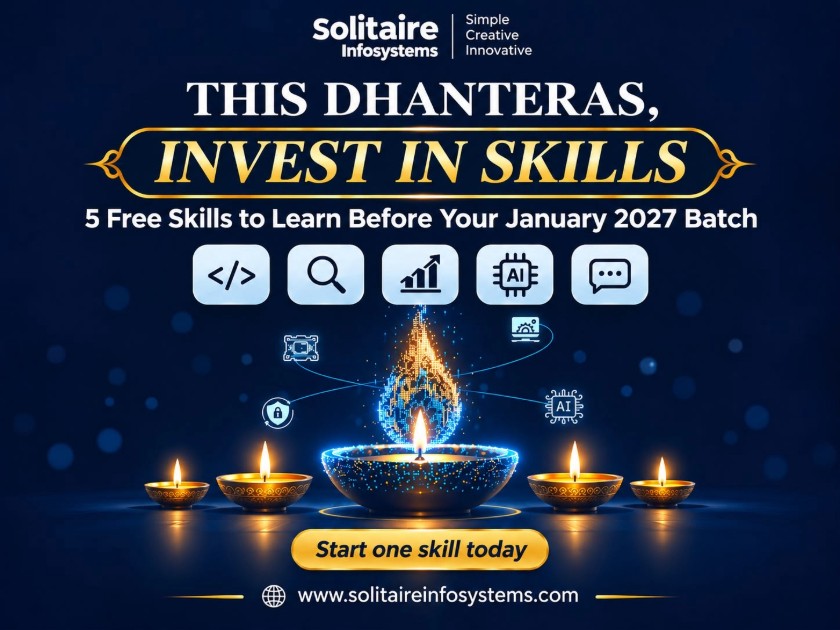
Free Skills to Learn Before January Batch: 5 Picks This Dhanteras
Request a Quote !

Request a Quote !

Request a Quote !

Blogs

This Dhanteras, Invest in Skills: 5 Free Skills to Learn Before Your January Batch

  • By: admin
  • date: Nov 11, 2026
Blog Image

The most useful free skills to learn before your January batch are programming basics, SEO and digital marketing fundamentals, data analysis in Excel or Google Sheets, sensible use of AI tools, and professional communication. You don’t need all five. Pick the one closest to your training domain, give it 30–60 minutes a day, and you’ll start your first week already knowing the vocabulary.

Dhanteras is when families buy something that holds its value: gold, a new utensil, sometimes a vehicle. If you have a January 2027 industrial training or internship batch coming up, the weeks between now and January are worth more than they look. An hour a day adds up to well over 40 hours of free learning before your batch begins.

This guide is from Solitaire Infosystems, a software development and IT training company in Mohali that runs industrial training and internship batches. It covers what to learn, where to learn it for free, and what to build so the time actually shows on day one.


Which free skill should you learn first?


Start with the skill your training domain depends on. If you haven’t chosen a domain yet, spreadsheets and communication are safe bets because every track uses them.

If you’re heading into… Start with Free place to begin
Python, AI/ML, MERN stack, React JS, software testing Programming basics freeCodeCamp, Programiz
Web designing, UI/UX, graphic designing HTML/CSS basics and design principles W3Schools, freeCodeCamp
Digital marketing SEO fundamentals Google Search Central, Google Skillshop
Cyber security, ethical hacking, networking How networks work and basic Linux commands Cisco Networking Academy (free intro courses)
Not sure yet Excel/Sheets and communication Microsoft and Google help centres, British Council LearnEnglish


1. What programming basics should you learn before training?


Programming sits underneath the Python, AI/ML, MERN stack, React JS and software testing tracks. You don’t need to be fluent before training starts. You need to be comfortable enough with the building blocks that your trainer’s examples make sense the first time.

Learn these first:

  • Variables and data types
  • If-else conditions
  • Loops and functions
  • Lists (arrays)
  • Reading error messages instead of panicking at them

Free resources: freeCodeCamp’s free coding curriculum, W3Schools and Programiz.

Stick to one language. Python is the easier start for most students; JavaScript makes more sense if you’re heading into web development or MERN.

Try this: Write a program that takes marks for five subjects and prints the total, percentage and grade. Then break it on purpose and read the error. That one habit saves hours later.


2. How do you learn SEO and digital marketing basics for free?


Digital marketing is much more than posting on Instagram. A large part of the daily work is search: finding out what people type into Google and shaping pages so they answer it.

Learn these first:

  • How search engines crawl, index and rank pages
  • Keyword research and search intent
  • On-page vs off-page SEO
  • What Google Analytics and Search Console each measure
  • Basics of social media marketing

Free resources: Google’s SEO Starter Guide, Google Skillshop and HubSpot Academy.

Try this: Search for any topic you care about and open the top five results. Write down each page’s title, its main heading and how quickly it answers the question. Within an hour you’ll start spotting the patterns SEO is built on.


3. Why learn data analysis in Excel or Google Sheets?


Sales, HR and marketing teams all run on spreadsheets. It’s the most transferable skill on this list, which makes it a good choice if you haven’t settled on a domain.

Learn these first:

  • Sorting and filtering
  • SUM, AVERAGE, COUNT and IF
  • VLOOKUP or XLOOKUP
  • Pivot tables
  • One clean chart per question you’re answering

Free resources: Microsoft’s Excel training pages, the Google Workspace Learning Center for Sheets, and Kaggle Learn once you’re ready for Python.

Try this: Download a free sample sales dataset from Kaggle. Find total sales by month and the top-selling product, then show it in one chart. That’s a mini dashboard you can talk through in an interview.


4. How should students use AI tools while learning?


Most students already use ChatGPT. Far fewer use it well. What gets noticed is knowing how to ask, and knowing when the answer is wrong.

Learn these first:

  • Writing specific prompts: give context, the level you’re at and the format you want
  • Using AI to explain a concept, then to quiz you on it
  • Spotting answers that sound confident but are wrong
  • Checking facts and testing code before you use it
  • The basic idea of machine learning: a model learns patterns from examples

Free tools: ChatGPT, Google Gemini and Microsoft Copilot (free tiers), and Google Teachable Machine.

Try this: Ask an AI tool to explain loops as if you’ve never coded, then ask for three practice questions. Solve them yourself before asking for the answers. On Teachable Machine, train a model to tell two hand gestures apart; it takes one short session and makes “training data” click.


5. Which communication skills matter before an internship?


In project reviews and interviews, the students who stand out aren’t always the strongest coders. They’re the ones who can explain what they built and why they built it that way.

Practice these:

  • A 60-second self-introduction
  • A short professional email asking a question
  • A one-page fresher resume
  • Explaining a project in three sentences: the problem, what you did, the result
  • Answering “Tell me about yourself” without reading from notes

Free resources: British Council LearnEnglish, Google’s Interview Warmup and interview practice videos on YouTube.

Try this: Record your self-introduction on your phone and listen back once. You’ll hear the filler words straight away.


What mistakes do students make while preparing?


These come up again and again with students starting a new batch:

  • Hopping between tutorials. Three Python courses each left at 20% teach less than one you finish.
  • Watching without typing. If you didn’t write the code yourself, you haven’t learned it yet.
  • Collecting certificates instead of building something. One small project you can explain beats five completion badges.
  • Leaving the resume for the last week. It always takes longer than expected.
  • Copying AI answers without checking them. Trainers spot it quickly, and so do interviewers.


How should you plan the weeks before your January 2027 batch?


Keep it simple: one track, 30–60 minutes a day, and something small to show at the end of each week.

Week Focus What you should have by Sunday
1 Choose your track and set up tools Tools installed and a daily time slot fixed
2 Core basics of your track 10 small practice exercises done
3 Core basics, continued One mini task: marks calculator, keyword list or sales chart
4 Excel or Google Sheets A one-page dashboard from a sample dataset
5 AI tools for learning A short set of prompts you reuse for revision
6 Resume and self-introduction Fresher resume and a recorded 60-second intro


If you have more time before your batch starts, repeat weeks 2 and 3 with a slightly bigger project.


Where can you continue with structured training in Mohali?


Free resources are good for the basics. What they don’t give you is feedback, deadlines or live project work, and that’s where structured training comes in.

Solitaire Infosystems, at Phase 7, Industrial Area, Mohali, offers 4-week, 6-week and 6-month industrial training, along with internships that include stipend-based options. The January 2027 batch covers 6-month industrial training, 6-month internships and stipend-based internships. Training domains include:

  • Python
  • Artificial intelligence and machine learning
  • MERN stack and React JS
  • Web designing
  • UI/UX and graphic designing
  • Digital marketing
  • Software testing
  • Cyber security, ethical hacking and networking

You can browse the industrial training programs in Mohali or read more about internship options at Solitaire Infosystems. Eligibility and duration depend on the program you choose.

Next step: Check the January 2027 batch details for 6-month industrial training, then send your questions through the Solitaire Infosystems contact page.


Frequently Asked Questions


What skills should I learn before joining industrial training?

Start with the basics of your chosen domain: programming for development tracks, SEO for digital marketing, and HTML, CSS and design principles for web and UI/UX. Add spreadsheet skills and communication practice, which help in every track.


Can I learn these skills for free?

Yes. freeCodeCamp, W3Schools, Google Skillshop, Google Search Central, HubSpot Academy and Kaggle Learn all offer free lessons. Free resources cover the fundamentals well; what they don’t provide is feedback on your work or live projects.


Do I need coding for digital marketing or UI/UX training?

Not for digital marketing. For UI/UX, coding isn’t the core skill, but basic HTML and CSS help you understand what developers can actually build from your designs.


How long does it take to learn Python basics?

With 30–60 minutes of daily practice, most beginners become comfortable with variables, loops and functions within a few weeks. Building real projects takes longer, which is where structured training helps.


How do I enquire about the January 2027 batch at Solitaire Infosystems?

Visit the January 2027 batch page or the contact page on the Solitaire Infosystems website, or visit the office at C-110, Phase 7, Industrial Area, Mohali, between 9:00 AM and 6:30 PM.


This Dhanteras, start with one skill

Gold holds its value. So does a skill you’ve actually practiced. Pick one track tonight, open one free resource, and finish your first lesson before the Diwali lights come down. By January, you’ll be the student who already knows what the trainer is talking about.


Planning your January batch? See the January 2027 industrial training batch at Solitaire Infosystems, Mohali.

About the Author

Comments