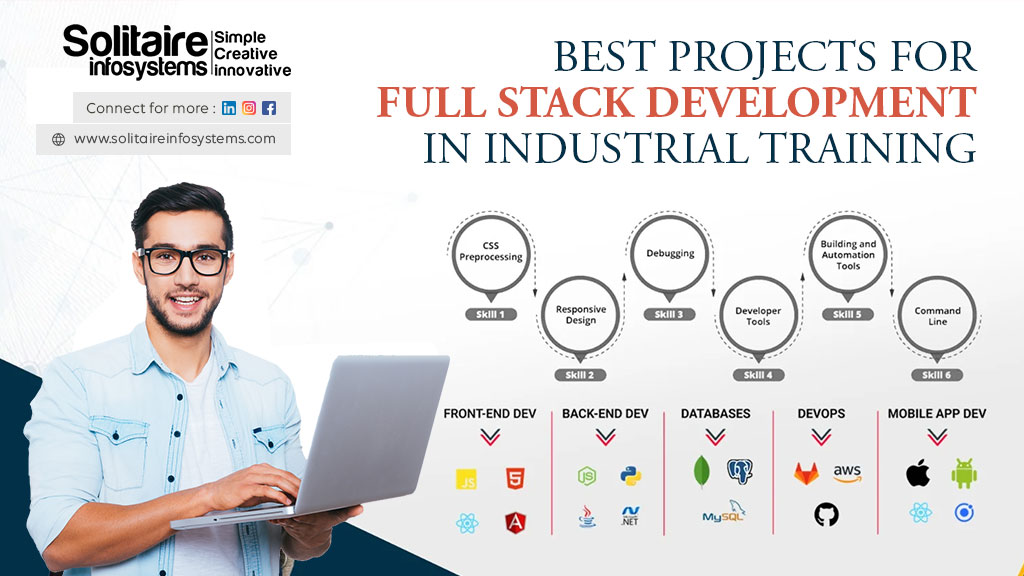
Best Projects for Full Stack Development in Industrial Training - Solitaire Infosystems
Request a Quote !

Request a Quote !

Request a Quote !

Blogs

Best Projects for Full Stack Development in Industrial Training

  • By: admin
  • date: May 21, 2025
Blog Image

Industrial training is pivotal for aspiring full-stack developers, offering a crucial bridge between theoretical knowledge and practical, real-world application. It’s not just about learning new frameworks; it’s about getting your hands dirty, solving real problems, and building a portfolio that truly shines.

So, what kind of projects should you focus on during this invaluable period? And if you’re in the Mohali region, where can you find the best opportunities to hone your full-stack development skills?


Why Project-Based Learning in Industrial Training Matters

Forget rote memorisation. The tech industry thrives on problem-solvers and builders. Projects during your industrial training are essential because they provide:

  • Practical, Hands-on Experience: You’ll debug, integrate, and deploy, facing the same challenges real developers do.
  • A Powerful Portfolio: Well-executed projects are concrete proof of your abilities, far more impactful than just listing technologies on your resume.
  • Skill Integration: Full-stack development is about making diverse technologies work together seamlessly. Projects force you to master this orchestration.
  • Problem-Solving Prowess: You’ll encounter unexpected hurdles, pushing you to think critically and innovatively.
  • Collaboration and Teamwork: Many training programs involve team projects, teaching you vital communication, version control (think Git!), and collaboration skills.


Top Full Stack Project Ideas for Industrial Training

Here are some impactful project ideas, offering a comprehensive learning experience and demonstrating a wide range of skills:

  1. E-commerce Platform with Advanced Features: This classic project covers almost every aspect of full-stack development. Think secure user authentication, product management (CRUD operations), a robust shopping cart, order processing, and even payment gateway integration (using sandbox environments for testing).
    • Technologies: Frontend (React, Angular, Vue.js), Backend (Node.js with Express, Python with Django/Flask, Java with Spring Boot), Database (MongoDB, PostgreSQL, MySQL), Deployment (AWS, Google Cloud, Heroku).
  2. Social Media Clone with Real-time Updates: This project highlights real-time communication and complex data handling. Include user profiles, real-time news feeds, likes, comments, and especially direct messaging with Web Sockets.
    • Technologies: Frontend (React, Angular, Vue.js), Backend (Node.js with Express and Socket.IO), Database (MongoDB, PostgreSQL).
  3. Project Management & Collaboration Tool: Showcase your ability to build applications for productivity and teamwork. Features could include user authentication, team creation, project and task management, Kanban board views, file sharing, and real-time notifications.
    • Technologies: Frontend (React, Angular, Vue.js), Backend (Python with Django/Flask, Node.js with Express), Database (PostgreSQL, MongoDB), Version Control (Git & GitHub).
  4. Healthcare Appointment Booking System: A practical application focusing on specific business logic, scheduling, and data security. Consider patient and doctor roles, doctor profiles, appointment scheduling with availability checks, calendar integration, and automated reminders.
    • Technologies: Frontend (React, Angular, Vue.js), Backend (Java with Spring Boot or Python with Django for robust enterprise features), Database (PostgreSQL, MySQL), Strong emphasis on security and data privacy.


Mastering Your Industrial Training

  • Start Small, Build Big: Don’t aim for a giant, complex system on day one. Implement core functionality first, then gradually add more features.
  • Become a Git Master: Version control is non-negotiable. Learn to commit frequently, branch, merge, and resolve conflicts.
  • Write Clean, Modular Code: Organise your code logically. Use functions and components to promote reusability and readability.
  • Understand Database Design: Invest time in designing an efficient and scalable database schema.
  • Implement Robust Error Handling: Ensure your application gracefully handles unexpected inputs and errors on both the frontend and backend.
  • Prioritise Security: Be aware of common web vulnerabilities (XSS, CSRF, SQL injection) and implement measures to prevent them.
  • Deploy Your Project: Getting your application live (even on a free-tier service) provides invaluable experience with deployment, domain configuration, and continuous integration.
  • Document Everything: Clear documentation of your code, API endpoints, and project decisions is a hallmark of a professional developer.


Conclusion

To summarise, securing industrial training at Solitaire Infosys in Mohali presents an excellent opportunity for aspiring full-stack developers to gain practical, real-world experience. Their programs are highly regarded for their emphasis on live projects, guidance from experienced mentors, and alignment with current industry demands.

When applying, ensure you thoroughly research their specific full-stack development programs, tailor your resume to highlight relevant skills, and be prepared for an interview that assesses both your technical knowledge and problem-solving abilities. By actively engaging with the training, focusing on the provided live projects, and leveraging their placement assistance, you can transform your academic understanding into tangible skills, significantly enhancing your portfolio and paving the way for a successful career in full-stack development.

About the Author

Comments