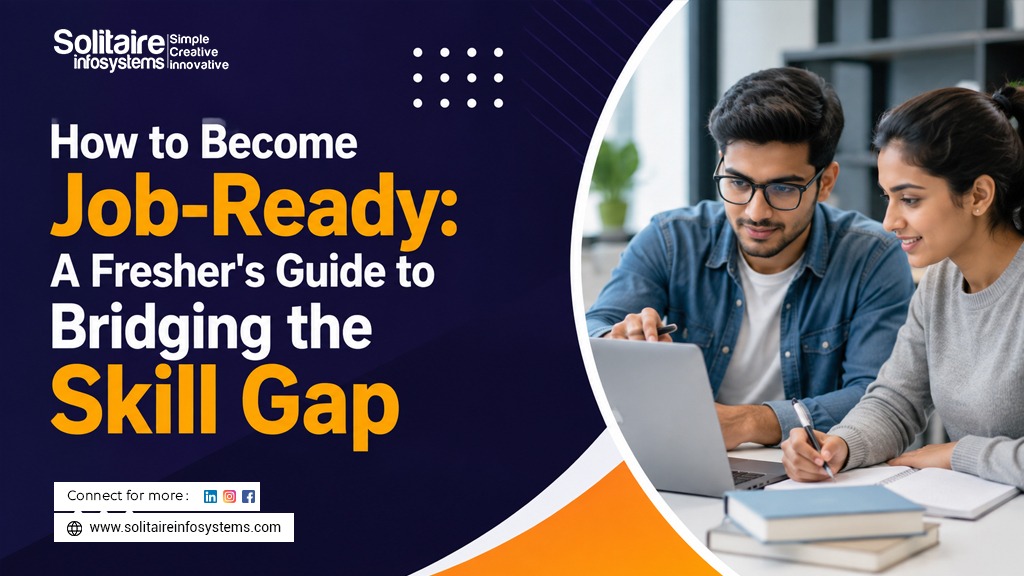
How to Become Job-Ready: A Fresher's Guide to Bridging the Skill Gap - Solitaire Infosystems
Request a Quote !

Request a Quote !

Request a Quote !

Blogs

How to Become Job-Ready: A Fresher’s Guide to Bridging the Skill Gap

  • By: admin
  • date: Sep 4, 2026
Blog Image

Every year, thousands of IT graduates walk out of college with a degree in hand—and still struggle to land their first job. It’s not because they lack intelligence or effort. It’s because there’s a gap between what colleges teach and what companies actually need. This is known as the skill gap, and closing it is the single biggest factor that separates freshers who get hired quickly from those who send out a hundred resumes and hear nothing back.

If you’re a student or recent graduate wondering why your degree alone isn’t enough, this guide breaks down exactly what job-ready skills mean, why the gap exists, and how you can bridge it step by step.


What Does “Job-Ready” Actually Mean?

Being job-ready doesn’t mean knowing everything about your field. It means you can walk into a role and contribute meaningfully within your first few weeks, without needing months of hand-holding. Recruiters use the term to describe candidates who combine three things:

  • Technical competence—you can actually do the work, not just talk about it in theory
  • Workplace readiness—you understand deadlines, collaboration, and professional communication
  • Applied experience—you’ve worked on real or real-world-style projects, not just exam-based assignments

A candidate with all three moves through interviews faster and settles into a first job with far less friction.


Why the Skill Gap Exists

Most engineering and IT curriculums are updated slowly, while the tech industry moves fast. A student might graduate having studied programming fundamentals and theory-heavy subjects but never touched a live project, a version control system, or a real client requirement. Meanwhile, companies are hiring for practical, immediate contribution—not academic potential.

The result is a mismatch: students have knowledge, but not always the skills for IT freshers that employers are actively screening for. The good news is that this gap is entirely fixable, usually within a few months of focused effort.


The Core Job-Ready Skills Every Fresher Needs


Technical Skills That Match Real Job Descriptions

Instead of learning technology broadly, freshers should study actual job postings in their target role and reverse-engineer the skill list. Common technical skills for freshers in high demand include

  • A programming language relevant to your track (Python, Java, JavaScript, or PHP)
  • Front-end or back-end web development frameworks
  • Database fundamentals (SQL, basic schema design)
  • Version control with Git and GitHub
  • Basic understanding of cloud platforms or deployment
  • For specialized tracks: exposure to AI/ML libraries, mobile app frameworks, or digital marketing tools

The key isn’t breadth—it’s depth in two or three areas that align with the jobs you’re actually applying for.


Project Experience You Can Talk About

A resume line that says “completed coursework in web development” carries far less weight than “built and deployed a full-stack e-commerce application using React and Node.js.” Employers want proof you can apply knowledge, not just recall it. Build 2–3 solid projects, host the code on GitHub, and be ready to explain your decisions in an interview.


Communication and Collaboration Skills

Technical ability gets you shortlisted; communication skills often decide who gets hired. Freshers need to practice explaining technical concepts in plain language, writing clear emails and documentation, and working within a team using tools like Jira, Slack, or Trello. These career skills for students are rarely graded in college but are evaluated constantly on the job.


Problem-Solving Under Real Constraints

Classroom problems come with clean inputs and clear answers. Real work doesn’t. Freshers who can debug an unfamiliar codebase, work with incomplete requirements, or figure out a fix under a deadline stand out immediately. This skill is built almost entirely through hands-on exposure—not lectures.


Adaptability and a Learning Mindset

Technology changes constantly. Employers aren’t just hiring for what you know today—they’re hiring for how quickly you can learn what you don’t know yet. Freshers who show curiosity, ask good questions, and pick up new tools quickly are seen as lower-risk hires.


Why Internships Are the Fastest Way to Close the Gap

Reading about industry-ready skills and actually building them are two different things. This is where internships make the biggest difference. A structured internship gives you:

  • Exposure to live projects and real client or business requirements
  • Mentorship from experienced professionals who review your work
  • Practice with the tools and workflows companies actually use
  • A genuine answer to “tell me about a time you solved a problem at work” in future interviews
  • A reference and, in many cases, a foot in the door for a full-time offer

Internship skills—things like working within a sprint, taking feedback on code reviews, or presenting progress to a team — are almost impossible to fake on a resume. They show up naturally once you’ve actually done the work.


A Step-by-Step Roadmap to Becoming Job-Ready

  • Pick a specialization. Don’t try to learn everything. Choose a track — web development, mobile apps, data science, digital marketing, oanother—baseded on interest and market demand.
  • Learn the core technical stack. Focus on the 2–3 tools or languages that dominate job postings in your chosen track.
  • Build real projects. Recreate a simplified version of an app or platform you use daily. Push it to GitHub with a clean README.
  • Get hands-on industrial training or an internship. This is where theoretical skills turn into job-ready skills, under real supervision and real deadlines.
  • Polish your resume and LinkedIn around outcomes. Instead of listing skills, list what you built and what problem it solved.
  • Practice interviews and communication. Mock interviews, group discussions, and explaining your projects out loud all sharpen the skills recruiters actually test for.
  • Apply strategically. Target roles that match your actual skill level first, then move up as your experience grows.


Final Thoughts

Becoming job-ready isn’t about being perfect before you apply—it’s about closing the specific gaps that make hiring managers hesitate. Technical skills, real project experience, communication ability, and structured exposure through internships or industrial training are what turn a fresh graduate into a confident, hireable candidate.

If you’re looking for hands-on internship and industrial training programs designed specifically to make you job-ready, Solitaire Infosystems offers practical, mentor-led training across web development, mobile apps, AI/ML, digital marketing, and more—helping students and freshers build the exact skills employers are hiring for.

Ready to bridge the skill gap? Apply for an internship or explore our industrial training programs today.

About the Author

Comments