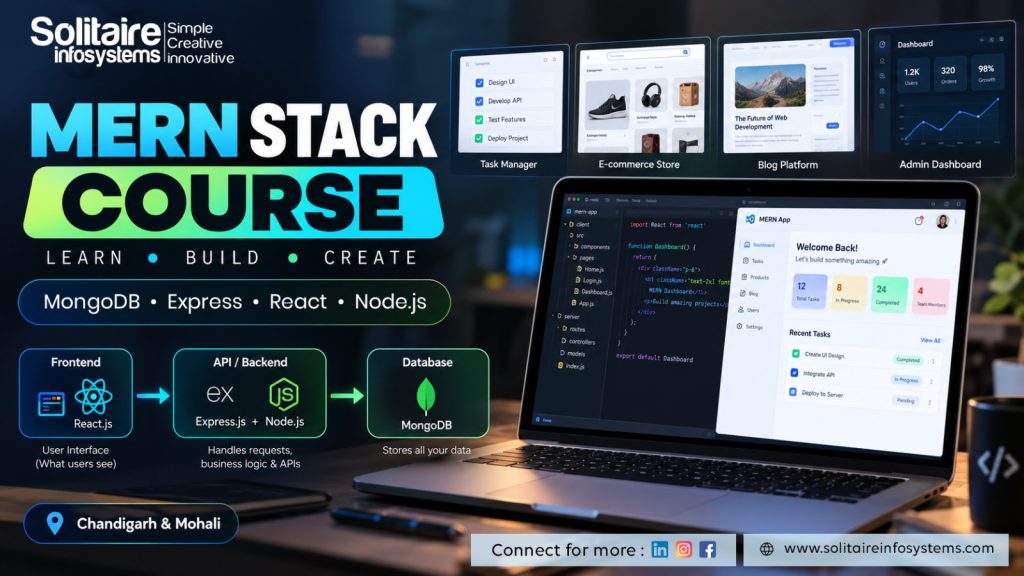
MERN Stack Course in Chandigarh | Solitaire Infosystems
Request a Quote !

Request a Quote !

Request a Quote !

Blogs

MERN Stack Course in Chandigarh: What You’ll Learn and Build

  • By: admin
  • date: Aug 13, 2026
Blog Image

A MERN stack course in Chandigarh teaches you to build complete web applications using JavaScript: React for the interface, Node.js and Express for the server and APIs, and MongoDB for the database. At Solitaire Infosystems in Mohali, you can take it as 6-week industrial training or a 6-month program, building working projects throughout.

A lot of people who search for a MERN course have already tried learning from YouTube. They can follow a React tutorial line by line. But ask them to build something on their own — a login system, a cart that saves orders to a database — and the pieces don’t connect. Closing that gap is the whole point of a structured course.

Below: what MERN actually is, what we cover and in what order, the projects you’ll build, and how to choose between the 6-week and 6-month routes.


What Is the MERN Stack?

MERN is four tools that work together to run a web application:

  • MongoDB — the database. It stores data as JSON-like documents instead of rows and tables, which feels natural when the rest of your code is JavaScript.
  • js — a small framework that sits on Node.js and handles routes and APIs.
  • React — the library for the part users see. You build pages out of reusable components.
  • js — lets JavaScript run on the server, not just in the browser.

The real reason MERN suits beginners: it’s one language from top to bottom. You still have four tools to learn, but you’re not switching between JavaScript, PHP and SQL every time you move from the browser to the server.


What You’ll Learn — and Why the Order Matters

We don’t start with React. Students who jump straight into it tend to get stuck the moment something breaks, because they can’t tell whether the problem is React or plain JavaScript. So the course builds up in this order.


HTML and CSS

Semantic HTML, forms, Flexbox, CSS Grid and responsive layouts that actually work on a phone. It’s the least exciting part, and it shows up in every project you’ll ever make.

JavaScript

This is where most of the real learning happens. Arrays and objects, functions, DOM manipulation, ES6+ features like restructuring, arrow functions and modules, then promises and async/await. If async/await doesn’t click, data fetching in React and routes in Express won’t either — so we spend proper time here.

React.js

Components and JSX, props and state, hooks such as useState and useEffect, handling forms, routing with React Router, and calling APIs. By the end of this stage you can build a multi-page frontend that pulls in live data.


Node.js and Express.js

Setting up a server, using npm packages, writing routes and middleware, building REST APIs, handling errors, and adding user authentication. This is the stage where your React app stops being a static demo and starts talking to a backend you wrote yourself.


MongoDB

Collections and documents, CRUD operations, queries, and designing a data model that won’t fall apart when your app grows. You’ll connect MongoDB to your Express server and see the full request travel from a button click to the database and back.


Git and GitHub

Version control isn’t a separate topic at the end — you use it from the first week. Every project goes on your own GitHub, which is often the first thing an interviewer opens.


Projects You’ll Build

For a first developer job, your projects say more than your certificate. Here are the kinds of applications students build, and what each one teaches:


Project What it teaches you
Task manager Full CRUD end to end — the first time your React frontend talks to your own API.
Blog with user login Authentication, protected routes and different permissions for different users.
E-commerce store Product listings, a cart and orders — more complex data and relationships.
Admin dashboard Fetching, filtering and displaying data in a way that’s actually readable.


How many of these you finish depends on the duration you choose. Six months naturally leaves room for more, and bigger, projects than six weeks.


6 Weeks or 6 Months: Which One Fits You?

6-week industrial training works well if you’re a B.Tech, BCA or MCA student who needs training as part of your degree, or if you already know some JavaScript and want structured, hands-on practice. Details are on our 6-week MERN stack industrial training page.

The 6-month programme suits you if you’re starting closer to zero or want to apply for developer jobs straight after. There’s time to get the fundamentals right and build a portfolio, not just finish one project. Here’s a breakdown of what a 6-month full stack training covers.

Not sure which one? Call us, tell us what you already know and what you’re aiming for, and we’ll point you to the one that makes sense.


Who Can Join?

B.Tech, BCA, MCA and B.Sc. (CS/IT) students, diploma holders, recent graduates, and anyone serious about becoming a web developer. Coding experience helps, but beginners can start with the fundamentals. What matters more is being willing to write code most days — that’s how this stuff sticks.


Jobs You Can Apply For After MERN Training

With solid projects behind you, you can apply for roles such as MERN stack developer, full stack developer, React or frontend developer, Node.js or backend developer, and JavaScript developer.

We won’t quote salary figures here. They vary too much with your skills, the strength of your projects, the city and the company to be useful as a single number.


Why Train at Solitaire Infosystems?

Solitaire Infosystems is a software development company, and training happens at our Mohali development office in Industrial Area Phase VII. That means you’re learning in a place where software is actually built, from people who work with these tools, not only teach them.

Alongside MERN, we run training and internships across other technologies too — see our industrial training in Mohali page if you’re still comparing options.


How to Compare MERN Courses in the Tricity

Whether you choose us or someone else, ask these questions before you pay:

  1. Can I see the syllabus? Check that JavaScript gets real time, not two days before React.
  2. What will I have built by the end? Ask whether the projects will be on your own GitHub.
  3. Who teaches? Trainers who build software for a living explain things differently from those who only teach it.
  4. Does the duration match my goal? College requirement and job readiness need different amounts of time.
  5. What’s the support after training? Ask exactly what career help includes. Be careful with “100% placement” promises.


Frequently Asked Questions


How long is the MERN stack course at Solitaire Infosystems?

You can choose 6-week industrial training or a 6-month programme. The 6-month route covers more ground and leaves room for more projects.


What are the fees?

Fees depend on the programme and duration you pick. Call +91-987-665-6700 or email info@solitaireinfosystems.com for the current fee.


Do I need to know coding before joining?

No, but basic computer skills and regular practice are essential. If you’re a complete beginner, the 6-month programme gives you time to build the fundamentals properly.


Where is the training held?

At our office: C-110, Industrial Area Phase VII, Mohali. If you’re in Chandigarh or anywhere else in the Tricity, this is where you’ll train.


What’s the difference between MERN stack and full stack development?

Full stack means working on both the frontend and the backend. MERN is one specific set of tools for doing that, built entirely on JavaScript. Other stacks use different tools — MEAN, for example, swaps React for Angular.


Talk to Us Before You Decide

Call +91-987-665-6700, email info@solitaireinfosystems.com, or visit us at C-110, Industrial Area Phase VII, Mohali. Bring your questions — about the syllabus, the duration, or whether MERN is the right stack for you at all.

Looking at other technologies as well? See our IT internship options.

About the Author

Comments