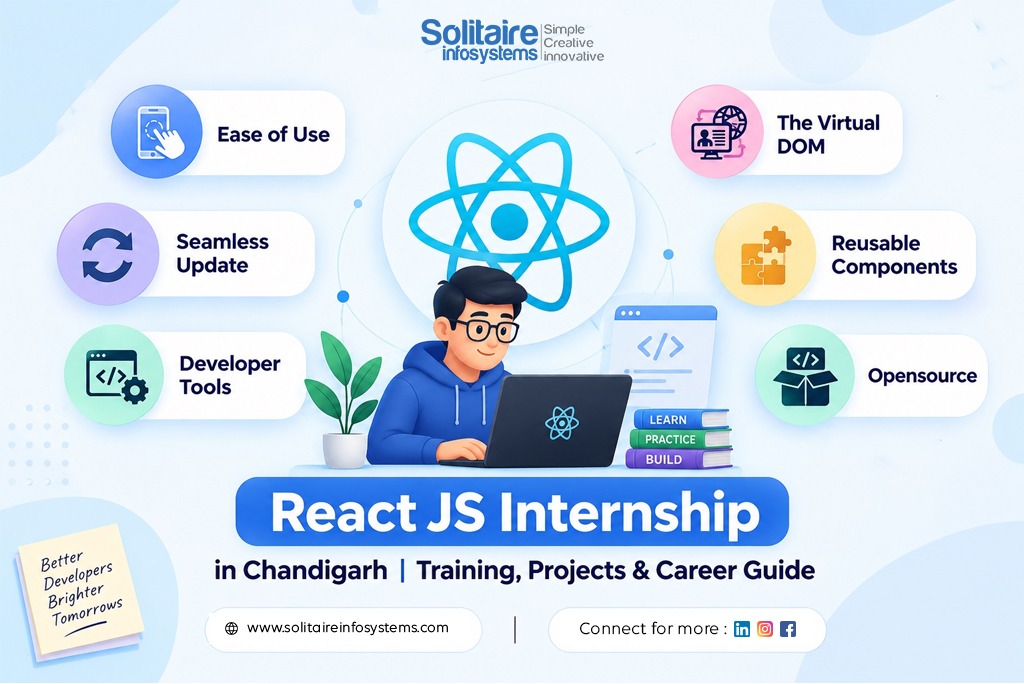
React JS Internship in Chandigarh | Training, Projects & Career Guide - Solitaire Infosystems
Request a Quote !

Request a Quote !

Request a Quote !

Blogs

React JS Internship in Chandigarh | Training, Projects & Career Guide

  • By: admin
  • date: Sep 8, 2026
Blog Image

If you are a student, recent graduate, or aspiring developer looking to start a career in web development, a React JS internship in Chandigarh can be a practical way to turn your programming knowledge into real-world skills.

React JS has become one of the most popular technologies for building modern, interactive web applications. However, simply learning React concepts is often not enough to become job-ready. Employers also look for candidates who understand frontend development, can work with APIs, build responsive interfaces, use Git, debug applications, and demonstrate their skills through practical React projects.

This is where structured React JS training combined with an internship can make a difference.

In this guide, we will explore what a React JS internship involves, why React is valuable for frontend development, what you can learn during an internship, which projects you should build, how freshers can prepare, and how to choose the right React internship in Chandigarh.


What Is a React JS Internship?

A React JS internship is a practical learning and work experience program designed to help aspiring developers understand how React is used to create real-world web applications.

Unlike learning React only through tutorials, an internship allows you to apply concepts such as components, props, state, hooks, routing, API integration, and form handling to actual development tasks.

A typical React internship may involve:

  • Developing responsive user interfaces
  • Creating reusable React components
  • Converting UI designs into functional web pages
  • Connecting applications with REST APIs
  • Managing application state
  • Working with React Hooks
  • Implementing navigation using React Router
  • Debugging frontend issues
  • Using Git and GitHub
  • Testing and improving applications
  • Collaborating with developers or project teams
  • Building portfolio-worthy React projects

For students and beginners, this practical exposure can help bridge the gap between learning React JS and becoming a confident frontend developer.


Why Choose a React JS Internship in Chandigarh?

Chandigarh and the surrounding Tricity region provide opportunities for students and aspiring developers interested in technology and software careers.

For someone who wants classroom learning combined with practical experience, a React JS internship in Chandigarh can provide a structured environment to develop technical and professional skills.

The biggest advantage of an internship is that it gives you an opportunity to learn by doing.

Instead of only watching videos or completing theoretical exercises, you can work on applications, solve development problems, receive feedback, and gradually understand how frontend development works in a professional environment.

A good internship can also help you:

  • Understand real development workflows
  • Strengthen your JavaScript fundamentals
  • Improve React development skills
  • Build practical projects
  • Create a stronger developer portfolio
  • Gain experience working with Git and APIs
  • Develop problem-solving abilities
  • Prepare for frontend development interviews
  • Understand expectations in software development roles


React JS Training vs. React JS Internship

One common question among beginners is whether they should choose React JS training or an internship.

The two approaches serve different purposes, although combining them can be particularly useful.

React JS Training

Training generally focuses on structured learning. It may cover:

  • HTML and CSS
  • JavaScript
  • ES6+ concepts
  • React fundamentals
  • Components
  • Props and state
  • Hooks
  • Routing
  • API integration
  • State management
  • Git and GitHub
  • Project development

Training is particularly useful when you are starting from the basics or need a structured curriculum.

React JS Internship

An internship focuses more heavily on applying what you have learned.

You may be expected to:

  • Build features
  • Fix bugs
  • Work with existing code
  • Develop components
  • Integrate APIs
  • Follow coding practices
  • Collaborate with other developers
  • Complete assigned React projects
  • Meet development requirements


Which One Should You Choose?

If you are completely new to React, starting with structured training can help you build a solid foundation.

If you already understand JavaScript and React fundamentals, an internship can help you gain practical experience.

For many beginners, the strongest approach is:

Learn → Practice → Build Projects → Intern → Create Portfolio → Apply for Jobs

This progression helps transform theoretical knowledge into demonstrable skills.


What Should You Know Before Starting a React Internship?

You do not necessarily need to be an expert before applying for an internship. In fact, internships are designed to help beginners gain experience.

However, having a basic understanding of the following technologies can give you an advantage.


HTML

You should understand how webpages are structured using elements such as:

  • Headings
  • Paragraphs
  • Forms
  • Buttons
  • Images
  • Links
  • Tables
  • Semantic HTML


CSS

You should have a working knowledge of:

  • Selectors
  • Box model
  • Flexbox
  • CSS Grid
  • Responsive design
  • Media queries
  • Basic animations


JavaScript

JavaScript is especially important because React is built around JavaScript.

Before starting React, you should understand:

  • Variables
  • Functions
  • Arrays
  • Objects
  • Loops
  • Conditions
  • DOM concepts
  • Array methods
  • ES6 syntax
  • Destructuring
  • Spread and rest operators
  • Promises
  • Async/await
  • Modules
  • Fetch/API concepts


Git and GitHub

Basic Git knowledge can make your internship experience much easier.

Learn how to:

  • Create repositories
  • Clone projects
  • Create branches
  • Commit changes
  • Push code
  • Pull updates
  • Create pull requests


What Will You Learn During a React JS Internship?

A quality internship should take you beyond basic syntax and introduce you to practical frontend development.

React Components

Components are one of the fundamental concepts in React.

You will learn how to create reusable components for elements such as:

  • Navigation bars
  • Buttons
  • Cards
  • Forms
  • Product listings
  • Modals
  • Dashboards

Understanding component-based development helps you create applications that are easier to maintain and scale.

Props and State

Props allow data to be passed between components, while state allows components to manage changing information.

Understanding the difference between props and state is essential for developing interactive React applications.

React Hooks

Hooks are an important part of modern React development.

During an internship, you may work with hooks such as:

  • useState
  • useEffect
  • useContext
  • useRef
  • useMemo
  • useCallback

You will learn when and why these hooks are useful in real applications.

React Router

Modern web applications often contain multiple views or routes.

React Router can be used to create navigation for pages such as:

  • Home
  • About
  • Products
  • Services
  • Profile
  • Dashboard
  • Contact

Learning routing helps you move from simple React components to complete applications.

API Integration

Real-world applications frequently communicate with backend services.

You may learn how to:

  • Send API requests
  • Retrieve data
  • Display API responses
  • Handle loading states
  • Handle errors
  • Submit form data
  • Work with JSON

API integration is an important skill for anyone pursuing frontend development.

Responsive Design

Users access websites from desktops, tablets, and smartphones.

As a frontend developer, you need to understand how to create interfaces that adapt to different screen sizes.

Your internship projects should ideally include responsive layouts rather than desktop-only interfaces.


The Importance of React Projects During an Internship

One of the most valuable parts of a React internship is project development.

React projects allow you to demonstrate that you can actually use the concepts you have learned.

A portfolio containing several practical projects can be much more useful than simply listing “React JS” on your resume.

Here are some project ideas for beginners and intermediate developers.


React To-Do Application

A To-Do application is a beginner-friendly project that can teach you:

  • State management
  • Event handling
  • Forms
  • Conditional rendering
  • Component creation
  • CRUD-style operations


Weather Application

A weather application can introduce you to API integration.

You can build features such as:

  • City search
  • Current temperature
  • Weather conditions
  • Loading indicators
  • Error messages
  • Responsive design


E-Commerce Website

An e-commerce application is a stronger portfolio project.

Possible features include:

  • Product listing
  • Product details
  • Search
  • Filtering
  • Shopping cart
  • Quantity management
  • Login interface
  • Checkout UI


Admin Dashboard

A dashboard can demonstrate more advanced frontend skills.

You can include:

  • Charts
  • Tables
  • Sidebar navigation
  • User management
  • Statistics
  • Search and filtering
  • Responsive layouts


Expense Tracker

An expense tracker can help you practice:

  • Forms
  • State management
  • Data filtering
  • Calculations
  • Reusable components
  • Local storage


Blog Application

A React blog can demonstrate:

  • Routing
  • Dynamic pages
  • API integration
  • Reusable components
  • Search
  • Categories
  • Pagination

The goal should not be to build dozens of projects. Instead, focus on creating a few React projects that demonstrate different skills and are polished enough to showcase in your portfolio.


React Internship for Freshers: What Should You Expect?

A React internship for freshers is generally designed to provide practical exposure while you continue developing your technical abilities.

Freshers should not expect to know everything before joining.

Instead, employers and mentors typically look for qualities such as:

  • Willingness to learn
  • Basic programming knowledge
  • Problem-solving ability
  • Interest in frontend development
  • Understanding of JavaScript fundamentals
  • Ability to accept feedback
  • Consistent practice
  • Curiosity about technology

Your first internship may involve relatively simple tasks. You could start by creating components, fixing styling issues, implementing small features, or resolving bugs.

As your confidence increases, you may work on more complex features and complete larger modules.


How to Prepare for a React JS Internship

If you want to maximize the value of your internship, prepare before applying.

Step 1: Strengthen JavaScript

Do not rush directly into React without understanding JavaScript.

Spend time practicing:

  • Functions
  • Arrays
  • Objects
  • Array methods
  • Promises
  • Async/await
  • ES6+
  • DOM manipulation
  • API requests

Step 2: Learn React Fundamentals

Start with the fundamentals before moving into advanced libraries.

Understand:

  • Components
  • JSX
  • Props
  • State
  • Events
  • Conditional rendering
  • Lists
  • Forms
  • Hooks

Step 3: Build Small React Projects

Practice is critical.

Start with simple applications and gradually increase complexity.

For example:

Beginner: To-Do App → Calculator → Quiz App

Intermediate: Weather App → Expense Tracker → Movie Search App

Advanced: E-Commerce App → Admin Dashboard → Full-featured Blog

Step 4: Learn Git and GitHub

Upload your projects to GitHub and maintain clean repositories.

A recruiter should be able to look at your repository and understand:

  • What the project does
  • Which technologies you used
  • How to run it
  • What features you implemented

Step 5: Build a Portfolio

Your portfolio should showcase your strongest work.

For each project, mention:

  • Project name
  • Problem solved
  • Technologies used
  • Key features
  • GitHub repository
  • Live demo, if available

Step 6: Prepare Your Resume

Keep your resume focused and relevant.

Highlight:

  • React skills
  • JavaScript
  • HTML/CSS
  • Git/GitHub
  • Projects
  • Internship experience
  • Relevant certifications or training

Avoid filling your resume with technologies you have only seen once or twice.


What Do Companies Look for in a React Intern?

Different organizations have different requirements, but a strong React intern commonly demonstrates several core abilities.

Technical Skills

You should aim to understand:

  • HTML5
  • CSS3
  • JavaScript
  • React JS
  • REST APIs
  • Git/GitHub
  • Responsive design

Knowledge of additional tools such as TypeScript, Redux, testing libraries, or modern build tools can be helpful depending on the role.

Problem-Solving Skills

Frontend development involves more than writing code.

You may need to figure out:

  • Why a component is not rendering
  • Why an API request is failing
  • Why a page is slow
  • Why a layout breaks on mobile
  • Why the state is not updating correctly

Developing the habit of debugging and researching solutions is therefore extremely valuable.

Communication

Developers often work as part of a team.

Being able to explain what you built, ask useful questions, understand requirements, and communicate problems clearly can make you a stronger intern.


How a React JS Internship Can Help Your Career

A well-structured internship can provide benefits beyond your technical skills.

Practical Experience

You get an opportunity to work on development tasks instead of learning only through theory.

Stronger Portfolio

Realistic applications can become portfolio projects that demonstrate your abilities to future employers.

Better Understanding of Development Workflows

You can become familiar with version control, task management, debugging, code reviews, and collaboration.

Career Direction

An internship can help you determine whether frontend development is the right career path for you.

Interview Preparation

The experience of building applications can make technical discussions easier because you can talk about problems you actually encountered and solved.


How to Choose the Best React JS Internship in Chandigarh

Not every internship provides the same learning experience.

Before joining a program, evaluate it carefully.

Check the Curriculum

A useful program should cover more than basic React syntax.

Look for topics such as:

  • JavaScript fundamentals
  • React fundamentals
  • Hooks
  • Routing
  • API integration
  • Responsive design
  • Git/GitHub
  • Project development
  • Debugging

Look for Practical Projects

Ask how many projects you will build and whether they resemble real-world applications.

A project-based internship is generally more valuable than one consisting primarily of lectures.

Ask About Mentorship

Beginners often learn faster when they can receive feedback from experienced developers.

Find out whether mentors review your code and help you understand development problems.

Review the Internship Structure

Understand:

  • Duration
  • Learning schedule
  • Project requirements
  • Technologies covered
  • Evaluation process
  • Certification, if applicable
  • Whether the work is individual or team-based

Evaluate the Portfolio Outcome

At the end of the internship, you should ideally have tangible evidence of what you learned.

That could include completed React applications, GitHub repositories, project documentation, or other demonstrable work.

Common Mistakes Beginners Make in React

Understanding common mistakes can help you learn faster.

Learning React Without JavaScript

React does not replace JavaScript knowledge. Weak JavaScript fundamentals can make React concepts unnecessarily difficult.

Copying Projects Without Understanding Them

Following a tutorial is useful, but simply copying code does not demonstrate development ability.

After completing a tutorial, modify the project by adding your own features.

Ignoring Responsive Design

A website that works only on a laptop is not a complete modern frontend project.

Practice creating mobile-friendly interfaces.

Building Too Many Small Projects

Ten unfinished projects are often less valuable than three polished projects.

Focus on quality, functionality, documentation, and presentation.

Ignoring Git

Git is an important part of modern software development. Learn the basics early.

Avoiding Debugging

Errors are a normal part of development.

Instead of being afraid of errors, learn how to read error messages, isolate problems, research possible causes, and test solutions.


React JS Internship Roadmap for Beginners

If you are starting from scratch, you can follow this learning roadmap:

Phase 1: Web Fundamentals

Learn HTML, CSS, responsive design, and basic web concepts.

Phase 2: JavaScript

Learn JavaScript fundamentals and modern ES6+ features.

Phase 3: React Fundamentals

Learn JSX, components, props, state, events, lists, forms, and hooks.

Phase 4: Advanced React

Explore routing, API integration, reusable architecture, state management, and performance concepts.

Phase 5: React Projects

Build multiple applications that solve practical problems.

Phase 6: Git & Portfolio

Upload your work to GitHub and create a professional portfolio.

Phase 7: React Internship

Apply your skills in an internship environment and gain practical experience.

Phase 8: Job Preparation

Prepare for frontend development interviews and entry-level opportunities.


Frequently Asked Questions About React JS Internship in Chandigarh

Is React JS good for freshers?

Yes. React is a popular frontend technology, and learning it alongside strong JavaScript fundamentals can help beginners pursue frontend development roles.

However, learning React alone is not enough. You should also practice HTML, CSS, JavaScript, responsive design, Git, APIs, and project development.

Can I do a React internship without experience?

Yes. Internships are often intended for students, beginners, and fresh graduates. Having basic JavaScript knowledge and a few personal projects can strengthen your application.

What should I learn before React JS training?

You should ideally learn HTML, CSS, and JavaScript fundamentals first. A strong understanding of JavaScript makes React considerably easier to understand.

How many React projects should I build?

There is no fixed number. Focus on building around 3–5 quality projects that demonstrate different skills rather than creating a large number of basic applications.

Is React JS training enough to get a job?

Training can give you the knowledge needed to start developing applications, but employability also depends on practical experience, projects, problem-solving, communication, interview preparation, and your overall understanding of frontend development.

Is a React internship useful for freshers?

Yes. A good internship can give freshers practical experience, project exposure, development workflow knowledge, and a stronger portfolio.

What can I become after learning React JS?

React skills can support career paths such as:

  • Frontend Developer
  • React Developer
  • UI Developer
  • JavaScript Developer
  • Web Developer
  • Full-Stack Developer, when combined with backend technologies


Start Your Frontend Development Journey with React

Learning React JS is not simply about understanding components and hooks. The real objective is to become capable of creating useful, responsive, and maintainable web applications.

For students and beginners, a React JS internship in Chandigarh can provide a bridge between classroom learning and practical frontend development.

The ideal journey is to build strong JavaScript fundamentals, complete structured React JS training, create meaningful React projects, learn professional development tools, and then apply those skills through a frontend development internship.

If you are a fresher, don’t wait until you feel that you know everything. Start with the fundamentals, build projects, learn from your mistakes, and continuously improve your portfolio.

Learn React. Build projects. Gain practical experience. Develop your portfolio. Take the next step toward a frontend development career.

About the Author

Comments