6 Months Industrial Training in Java: We Counted Real Job Listings Before Answering “Is Java Dead?” - Solitaire Infosystems
Request a Quote !

Request a Quote !

Request a Quote !

Blogs

6 Months Industrial Training in Java: We Counted Real Job Listings Before Answering “Is Java Dead?”

  • By: admin
  • date: Nov 2, 2026
Blog Image

Every few months, someone on social media announces that Java is dead. And every few months, a student sitting in a Mohali PG room reads that post and wonders if they are about to waste half a year.

If you are thinking about 6 months industrial training in Java, that is a fair worry. So at Solitaire Infosystems, we did not answer with opinions. We did what our trainers tell interns to do with any claim: check the evidence. Here is what we found, and what it means for your next six months.


So, is Java dead?


Short answer: no. Longer answer: it depends on what you mean by “dead.”

If dead means “nobody uses it,” the data disagrees. Java ranked third in the TIOBE index in January 2026, with a rating of 8.71%, behind Python at 22.61% and C at 10.99%. Other trackers agree that it sits near the top. A 2026 roundup of major rankings placed Java between #3 and #7 depending on the index, which is not what a dying language looks like.

If dead means “not trendy,” that is true, and also not a problem. Java is the language banks, insurance companies, e-commerce platforms and large enterprises quietly run on. Nobody tweets about it because it keeps working.

One more thing: popularity charts show what people search for, not what companies hire for. That is why we looked at job listings next.


How we counted real job listings


Charts are one thing. Hiring is another. So we did a simple exercise that you can repeat yourself in 20 minutes:

  1. Open two or three major job portals.
  2. Search “Java Developer,” then “Java Intern” and “Java Fresher,” filtering for Chandigarh, Mohali and remote.
  3. Open 30 to 50 listings and note what each one asks for.
  4. Tally the skills that appear again and again.


Whatever the totals are when you run it, the pattern in the skills column is the useful part. Listings that ask for Java almost never ask for Java alone.


What the listings really ask for


Read enough “Java Developer” job descriptions and the same stack shows up, almost like a shopping list:

  • Core Java: OOP, collections, exception handling, multithreading
  • Spring and Spring Boot: building REST APIs, the default in most Java backend jobs
  • Databases: SQL, MySQL or PostgreSQL, JDBC, and basic ORM such as Hibernate
  • Tools: Git, Maven, Postman, an IDE you actually know
  • Soft requirements: explaining your code, debugging calmly, working in a team

Notice what is missing: nobody asks “how many Java syntax rules can you recite?” Employers want someone who can build a working backend and explain it. That is the gap between a classroom course and industrial training.


Where freshers actually get stuck


Here is the honest part. Java is not dead, but one kind of Java learner is struggling: the one who finishes a course, collects a certificate, and has built nothing.

When we talk to students, the same three problems come up:

  • No projects. The resume lists “Java” but has nothing to show.
  • Tutorial dependence. They can follow a video but freeze when the screen is blank.
  • No interview practice. They know the answer but cannot say it out loud.

None of these is a Java problem. All of them are training problems.


What 6 months of industrial training in Java should look like


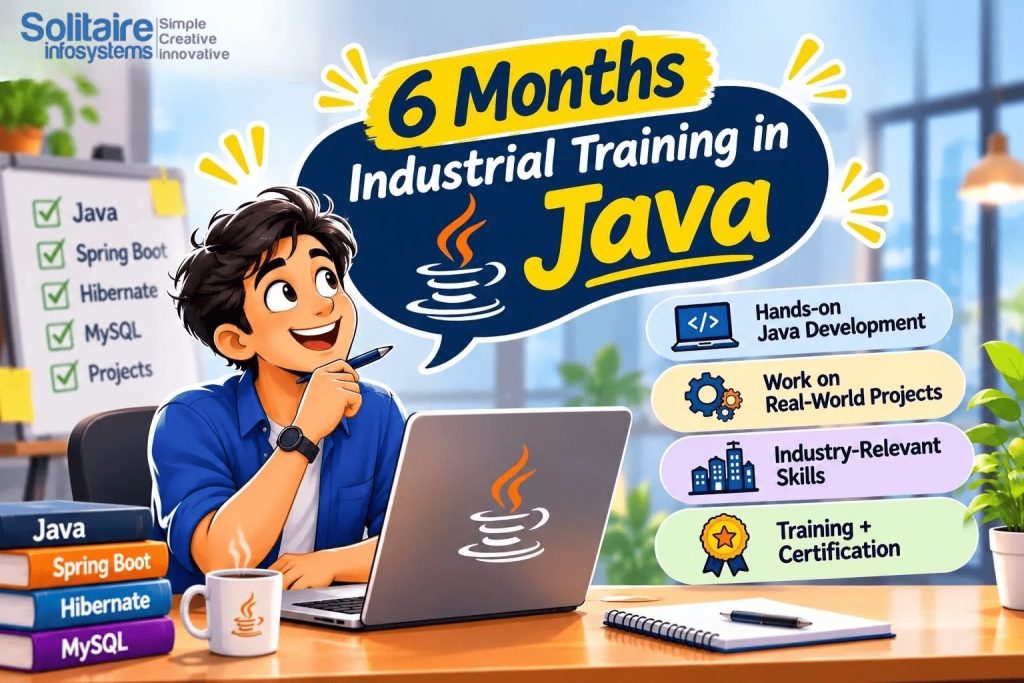
Six months is long enough to go from “I know the syntax” to “I have built something real.” A good programme should follow a progression like this:

Months 1 to 2: Foundations that stick. Core Java, OOP, collections, exceptions, and a modern version of the language including newer features like virtual threads. Daily coding practice, not just lectures.

Months 3 to 4: Backend skills. Databases, JDBC, Spring Boot, REST APIs, and Git workflows. This is where learners start building small working services.

Months 5 to 6: Real project work. A complete application, from design to deployment, with code reviews, debugging sessions and mock interviews.

That is the philosophy behind how we approach it at Solitaire Infosystems: less watching, more building, and constant feedback from trainers who work with the technology.


Industrial training vs. Java internship: what is the difference?


People often use these terms together, so here is the simple version.

                 Industrial training                            Java internship
   Main goal         Learn skills in a structured way                Apply skills on guided, real tasks
       Focus                 Concepts plus projects                   Practical work and workflow
     Best for            Students needing a solid base          Students ready to build and be reviewed


At Solitaire Infosystems, the Java internship is where training meets practice. You are not only learning what a Spring controller is. You are writing one, getting your code reviewed, fixing what breaks, and explaining your decisions. That experience is what makes a resume worth reading.


Who should (and should not) do this


It is a good fit if you:

  • are in a BTech, BCA, MCA or similar course and need industrial training
  • want a backend or enterprise development career
  • prefer building things over memorising theory
  • are willing to practise a little every single day


It may not be a fit if you:

  • want a job in a few weeks with no effort
  • only want a certificate without the work

We would rather say that honestly now than disappoint you later.


Java career paths after training


Once you have a strong base, there are several directions to go:

  • Java Backend Developer
  • Full Stack Developer (Java with a frontend framework)
  • Spring Boot Developer
  • Software Engineer in enterprise or fintech teams
  • QA Automation Engineer using Java-based tools

Java also sits underneath much of Android and large-scale enterprise software, so the skills carry over further than most students expect.


Quick takeaways


  • Java is not dead. It is a steady, enterprise-grade career language.
  • Job listings reward Java plus Spring Boot, databases and Git, not Java alone.
  • Certificates matter less than projects you can explain.
  • Six months of structured training, followed by real internship practice, is a strong route for freshers.


FAQs


1. Is Java still worth learning in 2026?
Yes. It remains near the top of major language rankings and is widely used in enterprise, banking and large-scale backend systems. It is especially good for students who want stable, long-term career options.

2.How long does it take to learn Java for a job?
Most freshers need around six months of consistent, hands-on learning to become job-ready, covering Core Java, Spring Boot, databases and at least one complete project.

3.Can a beginner with no coding background start 6 months industrial training in Java?
Yes. A good programme starts from the basics. What matters is regular practice, not prior experience.

4.What is the difference between Java and JavaScript?
They are different languages with different uses. Java is commonly used for backend and enterprise applications. JavaScript is mainly used for web interfaces and, with Node.js, for backend too.

5.Will I get to work on real projects?
Yes. Project work is a core part of the training, and the Java internship at Solitaire Infosystems is built around building and reviewing real applications.

6.Do I need Spring Boot as well as Core Java?
For most Java developer roles, yes. Core Java is the foundation, but Spring Boot is what most employers expect for backend work.

7.Is Java harder than Python?
Java is more structured and verbose, which makes it a little slower to start but very good at teaching solid programming habits.

8.How do I choose between training and an internship?
If you are new, begin with structured training. If you already know the basics, an internship helps you apply them. At Solitaire Infosystems, the two work together.


Not sure if you’re ready? Try the 3-question check


Answer yes or no:

  1. Do you want to build a real Java project, not just finish a course?
  2. Can you give daily practice time for the next six months?
  3. Would you like a trainer to review your code and tell you honestly what to improve?

Two or more yeses? Then talk to us. Call 9876656700 or visit solitaireinfosystems.com to ask about the 6 months industrial training in Java and the Java internship at Solitaire Infosystems, and find out which batch suits you.


About the Author

Comments