How Hackers Crack Passwords Like "Name@123" (and Why Your Hostel Wi-Fi Is Next) - Solitaire Infosystems
Request a Quote !

Request a Quote !

Request a Quote !

Blogs

How Hackers Crack Passwords Like “Name@123” (and Why Your Hostel Wi-Fi Is Next)

  • By: admin
  • date: Nov 2, 2026
Blog Image

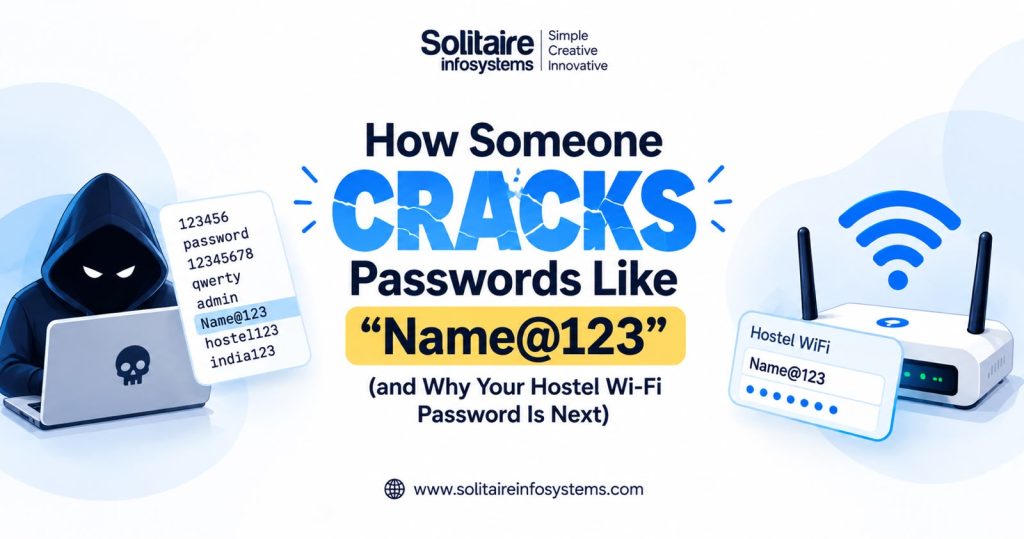
Hackers crack passwords like Name@123 by letting software do the guessing. Cracking tools start with lists of common names and words, then apply the same tweaks people make: a capital first letter, an @ or #, and a number like 123 or the current year. A password built on that pattern is one of the first things they try.

So if your Gmail, Instagram or any UPI-linked account uses something like Rahul@123, Priya2024 or Admin#99, change it today. The formula feels safe because it passes every “must include a symbol and a number” rule. That is exactly what makes it predictable.

Here is how hackers crack passwords in practice, why shared hostel and PG Wi-Fi makes it easier, and what actually keeps your accounts safe.


How do hackers crack passwords?


Nobody sits at a keyboard typing guesses. Attacks happen in one of two ways:

  • Online guessing: trying passwords on a live login page. Most sites lock or slow down repeated attempts, so attackers try a handful of very common passwords across thousands of accounts instead.
  • Offline cracking: when a website is breached, attackers often walk away with its database of stored (hashed) passwords. On their own machines there is no attempt limit, and a single modern graphics card can test billions of guesses per second against older, fast hashing methods.

Either way, the guesses are not random. They come from four main techniques.

1. Dictionary attacks

The tool works through a word list: real passwords leaked in past breaches, popular names, cricket players, film titles, city names. Public breach lists alone contain millions of real passwords, so if yours has ever been used by anyone else, it is probably on one.

2. Rule-based (hybrid) attacks

This is where Name@123 fails completely. Cracking tools come with rule sets that copy human habits: capitalise the first letter, swap “a” for “@”, add a symbol, append 123, 1234, a birth year or 2026. Run a few thousand names through a few hundred rules and you get millions of candidates, which a computer gets through almost instantly.


                   Password                                            Why the tools guess it fast
                    Rahul@123                         Common name + @ + 123. Covered by default rule sets.
                    Priya2024                   Name + recent year. Years are among the first suffixes tried.
                   hostel@2026                                               Place word + @ + current year.
                   Admin#99                                       Default-style word + symbol + two digits.


3. Brute force

Brute force tries every possible combination. It is only practical against short passwords, which is why length matters more than symbols. Every extra character multiplies the work.


4. Credential stuffing

This one is not cracking at all. When an email and password leak from one site, attackers automatically try the same pair on Gmail, Instagram, Amazon and banking apps. If you reuse passwords, one small breach opens every door.


Why are hostel and PG Wi-Fi networks easy targets?

In most hostels, one Wi-Fi password is shared by everyone, posted in a WhatsApp group and never changed. The router’s admin login is often still the factory default. That creates a few real risks:


  • A shared password is not private. On a WPA2-Personal network, anyone who knows the Wi-Fi password and captures a device’s connection handshake can decrypt that device’s Wi-Fi traffic. HTTPS still protects most websites and apps, but anything sent without it is exposed.
  • Weak Wi-Fi passwords can be cracked offline. The same handshake can be taken away and attacked with the rule-based methods above. A password like hostel@2026 would not last long.
  • Default router logins hand over control. Someone nearby who logs into the router can see connected devices or change DNS settings to quietly send users to fake login pages.
  • Small leaks spread. If the password you use for a hostel portal or a minor college site leaks, credential stuffing tools will try it on your main accounts too.


How do you protect your accounts from password cracking?

You do not need to memorise a 30-character random string. You need to stop being predictable.


  • Drop the Word + Symbol + Number formula. Cracking tools test it first, in every variation.
  • Use a passphrase. The UK’s National Cyber Security Centre recommends combining three random words. Pick your own unrelated words (not famous examples, which are already in cracking lists) and make it longer for important accounts.
  • Use a different password for every important account. A password manager makes this realistic; you only remember one strong master passphrase.
  • Turn on two-factor authentication (2FA). Even if a password is cracked, an authenticator app prompt stops the login. Prefer an authenticator app over SMS where offered.
  • Check whether you have been breached. Enter your email on Have I Been Pwned and change any password linked to a breach.
  • If you manage the hostel router: change the admin password, update the firmware, use WPA3 (or WPA2/WPA3 mode) if supported, and change the Wi-Fi password when residents move out.


Common password mistakes students make

  • Changing Rahul@123 to Rahul@1234 after a breach. Tools try that next.
  • Using the same password for the college portal and Gmail.
  • Saving passwords in a notes app or as a screenshot in the gallery.
  • Trusting the green “strong” meter on a sign-up page. Many meters only count symbols and digits, not predictability.


Want to learn how these attacks work, and how to stop them?

Reading about password cracking is one thing. Understanding how passwords are stored, how networks are secured and how systems are tested for weaknesses takes hands-on practice on real setups.

Solitaire Infosystems is a software development company in Phase 7, Industrial Area, Mohali, that also runs job-oriented IT training. Cyber security, ethical hacking and networking are among the tracks students can choose, alongside development and design programmes:

Admissions for the January 2027 batch of 6-month industrial training and internships are coming up.

A quick note: only test passwords, Wi-Fi and systems you own or have written permission to test. Unauthorised access is an offence under India’s Information Technology Act, 2000. Ethical hacking always starts with permission.


Frequently asked questions

1. How long does it take to crack a password like Name@123?

It depends on where the attack happens. On a live login page, attempt limits slow things down, but Name@123-style passwords are still among the first guesses. If a site’s password database leaks and it used an older, fast hashing method, a pattern like this can fall within seconds on ordinary cracking hardware.

2. Is adding @ and 123 enough to make a password strong?

No. Capitalising the first letter, adding a symbol and ending with 123 or a year are exactly the rules cracking tools apply automatically. They pass “must contain a symbol” checks without adding real strength.

3. Is a passphrase better than a complex password?

Usually, yes. Three or four genuinely random words are long, easy to remember and far harder to guess than a short word with symbols swapped in. Use a different one for every important account.

4. Can someone on the same hostel Wi-Fi see my passwords?

On websites and apps that use HTTPS, your password is encrypted even on shared Wi-Fi. The real risks are a compromised router sending you to fake login pages, older apps that do not encrypt traffic, and reusing a password that has already leaked. For banking, mobile data is the safer choice.

5. Where can I learn cyber security and ethical hacking in Mohali?

Solitaire Infosystems, a software development company in Phase 7, Industrial Area, Mohali, offers cyber security and ethical hacking as part of its industrial training and internship programmes, alongside other job-oriented IT courses.


Talk to our team

Want to know which cyber security or ethical hacking track fits your course and timeline? Call +91 98766 56700, email info@solitaireinfosystems.com, or contact Solitaire Infosystems to book a counselling call.


#PasswordSecurity #CyberSecurity #EthicalHacking #CyberSecurityTraining #SolitaireInfosystems

About the Author

Comments