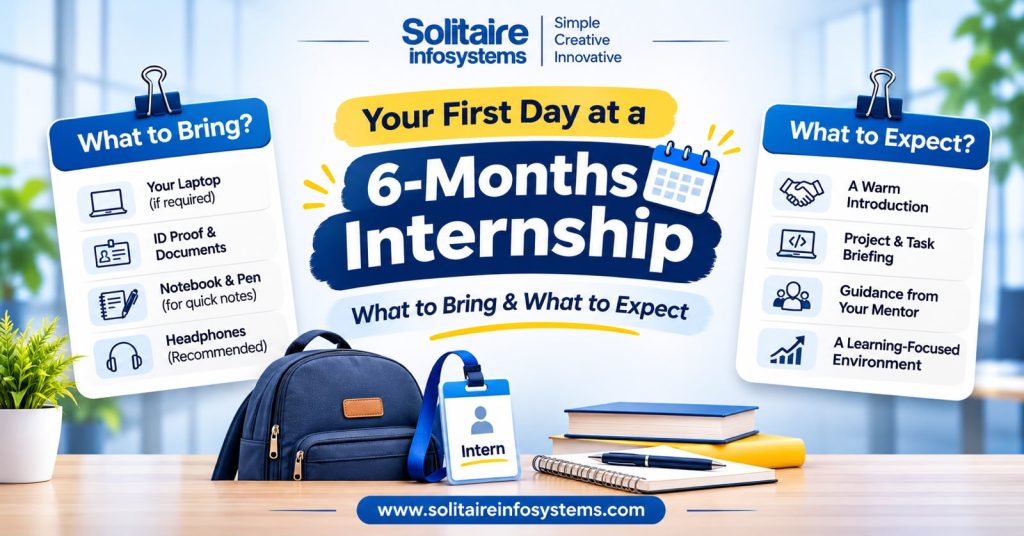
First Day at a 6-Month Internship: What to Bring & Expect
Request a Quote !

Request a Quote !

Request a Quote !

Blogs

Your First Day at a 6-Month Internship: What to Bring and What Happens

  • By: admin
  • date: Nov 14, 2026
Blog Image

Your first day at a 6-month internship is mostly about three things: joining formalities, meeting your trainer and team, and understanding your role and learning plan. Very few interns are handed a live project in the first hour. What you need to carry is short: an ID, two or three printed copies of your resume, your joining email or letter, and a notebook and pen.

This guide comes from Solitaire Infosystems, a software development and IT training company in Mohali that runs 6-month internships, 6-month industrial training and stipend-based internships. Below is what the first day usually looks like, what to bring, and how the six months tend to progress.


What should you bring on your first day?

Keep it light. You need the things that prove who you are and the things that help you take notes.


Documents

  • Updated resume — two or three printed copies
  • College ID card or another valid photo ID
  • Internship confirmation, offer or joining communication
  • Educational documents and passport-size photographs, if the organization asked for them


Everyday essentials

  • A notebook and two pens
  • Water bottle
  • Phone and charger
  • Laptop — only if you’ve been told to bring one
  • A folder to keep your papers together

Tip: pack your bag the night before. Hunting for an ID card at 8 AM is the most avoidable stress of the whole internship.


What happens when you reach the office?


Expect a slow, structured start. Most organizations follow roughly the same sequence.


Reporting and formalities

You’ll report to HR or the coordinator, who checks your documents and confirms your joining details. If you’re unsure about your duration, timings or who you report to, ask now — it’s the easiest moment to clarify.


Meeting your trainer and team

You’ll be introduced to your trainer or mentor and often to other interns. Note down names and who handles what. Nobody expects you to show off technical knowledge today; being attentive and polite is enough.


 Office rules and working culture

You’ll usually hear about:

  • Office timings and attendance
  • Breaks and leave procedure
  • Which channel to use for questions (chat group, email, in person)
  • How tasks are assigned, reported and reviewed


Your role and learning plan

Your trainer explains your track, the tools you’ll use and what you’ll cover first. At Solitaire, starting topics look roughly like this, though the exact plan depends on the program and on what you already know:


Internship track What you usually start with
Web designing / MERN stack HTML, CSS, JavaScript and how a website is structured
Python Syntax, data types and basic programming logic
ML / AI Python foundations before any model-building
Digital marketing SEO basics, keyword research and auditing a website
UI/UX and graphic designing Design principles, wireframes and tool basics
Software testing Testing types, writing test cases and bug reports
Cyber security / ethical hacking Networking fundamentals and core security concepts


Will you get a project on your first day at a 6-month internship?


Usually not. Day one is orientation. Most interns spend the first days setting up tools and learning concepts, then move to small assignments. Over six months, the progression typically looks like this:

Period What you focus on
Month 1 Tools, terminology and fundamentals of your track
Month 2 Practice exercises and small assignments
Months 3–4 Larger tasks, features or analysis under guidance
Months 5–6 Project work, refining your output and handling responsibilities more independently

Treat this as a typical pattern, not a fixed schedule. Your pace depends on your field and how consistently you practice.


What should you do — and avoid — on day one?


Do


  1. Arrive 10–15 minutes early. Solitaire’s office hours are 9:00 AM to 6:30 PM, so reaching by about 8:45 AM gives you time to settle in.
  2. Write things down. Setup steps, login details, names. Asking once is fine; asking for the same instruction three times isn’t.
  3. Keep your introduction short. Name, college and course, your internship track, and one thing you want to learn.
  4. Watch how the team works. How people ask for help, report progress and discuss problems tells you more than any rulebook.
  5. Say so when you don’t understand. Pretending to know a tool costs you more time later than admitting it now.


Avoid


  • Arriving late without informing anyone
  • Scrolling your phone while someone is explaining a task
  • Copying code you can’t explain — it runs today and leaves you stuck in an interview later
  • Comparing your speed with the intern next to you
  • Treating the internship as a certificate rather than six months of practice

One pattern trainers see often: a fresher gets stuck on a setup step in the morning and stays quiet until evening. Raise it within the first 20–30 minutes of being stuck. Nobody minds the question; losing a full day to it is the real problem.


What should you ask your trainer in the first week?


  1. Which tools and technologies will I cover, and in what order?
  2. How will tasks be assigned and how should I report progress?
  3. When do I move from exercises to project work?
  4. How will my progress be reviewed?
  5. Who do I contact if I’m blocked on a technical problem?


What should you do after your first day?


Spend 15–20 minutes that evening going over the day:

  • Write down the new terms and concepts you heard
  • Re-read any setup or technical instructions your trainer shared
  • List two or three topics you need to revise
  • Get your bag ready for tomorrow

Keep one internship notebook (or a single doc) for commands, shortcuts, errors you fixed and questions. By month six it becomes your interview prep sheet — you’ll be able to explain what you built and the problems you solved along the way.


Is a 6-month internship worth it for freshers?


It can be, if you put in the practice. Six months is long enough to move from basics to real assignments, get comfortable with industry tools, and work with a trainer and team. A short course rarely gives you that.

It isn’t automatically valuable, though. An intern who attends but never practices ends up with a certificate and little to talk about in an interview. The return comes from consistency: daily practice, finished assignments and understanding your own project well enough to explain it. If you’re comparing options, look at the tracks and structure of Solitaire’s 6-month internship programs alongside any other offer you have.


Frequently asked questions


What should I wear on the first day of an internship?

Clean, comfortable, smart-casual clothing. Follow the dress code if you were given one; if not, avoid very casual wear like shorts or slippers.


Do I need to bring my own laptop to an internship?

Only if the organization asked you to. Confirm this before your joining date so you aren’t caught out.


Will I get a project on the first day of my internship?

Usually not. The first day covers formalities, introductions and your learning plan. Project work typically starts after you’ve covered the fundamentals.


What if I know very little about the technology before joining?

That’s common for freshers. Revise the basics of your track before day one, take notes during training and practise every day. Trainers expect to start from fundamentals.


How long is a 6-month internship, and what happens month by month?

It runs about six months: the first month on fundamentals, the second on practice and small assignments, months three and four on larger tasks, and the last two on project work and refinement.


Ready for your first day?

You don’t need to be perfect on day one. Turn up on time, carry the essentials, take notes and ask when you’re stuck — that’s what the first day is for. The real growth happens in the weeks that follow.

Solitaire Infosystems runs 6-month internships and 6-month industrial training at its office in Phase 7, Industrial Area, Mohali. If you’re planning to join the January 2027 batch, see the current 6-month internship tracks or read the step-by-step guide to applying for a 6-month internship.

About the Author

Comments