January Internship Checklist: What to Prepare Before Your 2027 Internship Starts - Solitaire Infosystems
Request a Quote !

Request a Quote !

Request a Quote !

Blogs

January Internship Checklist: What to Prepare Before Your 2027 Internship Starts

  • By: admin
  • date: Nov 14, 2026
Blog Image

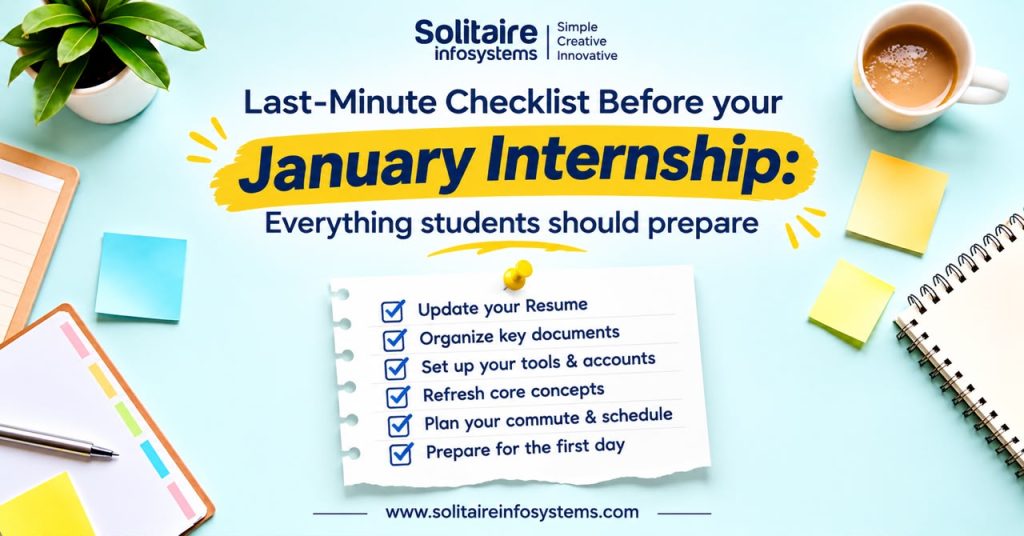
A January internship checklist covers ten things: confirm your joining details, keep your documents ready, revise the basics of your technology, update your resume, set up your laptop, learn basic workplace habits, prepare questions for your mentor, set learning goals, plan your travel or online setup, and decide what you want to have achieved by the end. If you start two to three weeks before your joining date, most of it takes a few evenings.

This guide is for B.Tech, BCA, MCA, BSc and diploma students starting an internship or 6-month industrial training in January 2027. Work through it in order, then use the short checklist near the end the night before day one.


1. What should you confirm before your joining date?

Get these in writing, by email or offer letter, rather than relying on a phone call:

  • Joining date and reporting time
  • Office address, or the meeting link if the internship is online
  • Mode: in-office, online or hybrid
  • Duration and weekly schedule
  • Technology or department you have been assigned
  • Name and contact number of your mentor or reporting person
  • Stipend terms (if any) and any other conditions

Tip: Save the confirmation email and offer letter on both your phone and laptop. On day one, someone at reception will almost always ask for it.


2. Which documents should you keep ready?

Most students collect documents only when HR asks. Keep one physical folder and one digital folder with:

  • Updated resume (PDF)
  • College ID card
  • Government ID proof, if asked
  • Passport-size photographs, if required
  • Internship offer or confirmation letter
  • Marksheets or academic details, if asked
  • Certificates or project reports, if relevant

Still applying? Keep the digital folder anyway, with your resume, academic details, and portfolio or GitHub link, so you can respond to an opening the same day.


3. What should you revise before a technical internship?

You are not expected to know everything on day one. Interns who struggle are usually the ones who never revised the basics, so the first two weeks go into catching up instead of building. Revise the fundamentals of your track:

Python and AI/ML

  • Variables, loops, functions and error handling
  • Lists, dictionaries and basic OOP
  • Reading a CSV and simple data handling
  • What a machine learning model does, in plain terms

The official Python tutorial covers all of these and is free.

Java

  • Core Java and OOP: classes, objects, inheritance
  • Exception handling
  • Collections
  • Basic SQL and database concepts

MERN stack and React

  • HTML, CSS and JavaScript fundamentals
  • DOM basics
  • React components, props and hooks
  • What an API request and response look like

Data analytics

  • Excel formulas, sorting, filters and pivot tables
  • Basic SQL queries (SELECT, WHERE, GROUP BY)
  • Cleaning messy data
  • One chart tool: Power BI or Python

Digital marketing

  • SEO basics: keywords and on-page SEO
  • How social media posts are planned and measured
  • Google Analytics and Search Console basics
  • How a basic ad campaign is set up


4. How should you update your resume before the internship?

Your mentor may read your resume to decide what to give you first. Make sure it shows:

  • Current education details
  • Technical skills that match your internship track
  • Academic and personal projects
  • Certifications, if you have any
  • LinkedIn, GitHub or portfolio link

For each project, write one line on what you built, one on the tools you used, and one on what you personally did. Two clearly explained projects say more than ten certificates.


5. Which tools should you install on your laptop?

Setting up software on day one eats into time you could spend learning. Install the basics for your track beforehand:

Internship track Tools to install or explore
Python / AI-ML Python, VS Code, Jupyter Notebook
Java JDK, IntelliJ IDEA or Eclipse
MERN / React VS Code, Node.js, Git
Data analytics Excel, Power BI, MySQL
Graphic design / UI-UX Photoshop, Illustrator, Figma or Canva
Digital marketing Google Analytics, Search Console, an SEO tool


Also check your free storage, internet connection, a professional email ID and a GitHub account. If you are new to version control, the free Pro Git book explains it clearly. If the company gives you its own setup instructions or access, follow those instead.


6. What do companies expect from interns in the first few weeks?

Technical skill is only half of it. From what mentors see every batch, the common first-month mistakes are not about code:

  • Staying stuck in silence. Spending two days on an error without asking. Try for an hour or two, then ask, and show what you already tried.
  • Not writing things down. When a mentor explains a setup or process, note it. Being asked the same thing twice costs trust.
  • Missing small deadlines. Reporting time and daily updates matter as much as the final project.
  • Treating feedback as criticism. Code review comments are how you learn fastest.

Show up on time, share a short update on your progress, and take ownership of your task. That is most of what “professional” means in an internship.


7. What should you ask your mentor in week one?

  • What will my learning roadmap look like?
  • Will I work alone or in a team project?
  • How will my progress be reviewed?
  • How often can I expect feedback?
  • Which skills should I focus on by the end?


8. How do you set realistic learning goals?

Decide what you want to finish, not just how long you will attend. A rough guide:

Duration A realistic goal
4–6 weeks Clear fundamentals and finish one guided project
2–3 months Build practical skills and a small working application
6 months Job-oriented skills and multiple projects you can explain in an interview


These are guides, not promises. Your progress depends on where you start, how fast you learn and how consistent you are.


9. How should you plan travel, stay or your online setup?

If you are moving to Mohali or Chandigarh for offline industrial training, sort these out before January:

  • Distance between your PG or hostel and the office
  • Daily commute options and travel time
  • Monthly rent, food and other expenses
  • Office reporting time versus college commitments

For an online internship, set up a quiet space, headphones and a stable connection before your first session.


10. What should you have by the end of your internship?

The certificate matters, but interviewers ask about the work. Aim to leave with:

  • Hands-on experience with tools used in your field
  • At least one project you can demo and explain
  • A stronger resume and GitHub or portfolio
  • Better communication and teamwork habits
  • More confidence for technical interviews

Keep a simple log of tasks, feedback and projects from week one. It makes your resume and interview answers much easier to write later.


The quick January internship checklist

Run through this the night before day one:

  • Joining date, time and mode confirmed
  • Offer letter or confirmation saved
  • Office address and mentor contact saved
  • Documents ready (physical and digital)
  • Resume updated
  • Fundamentals revised
  • Laptop and software checked
  • GitHub or portfolio updated
  • Travel, stay or online setup done
  • Learning goals written down
  • Questions for your mentor ready


Still looking for a January 2027 internship or industrial training in Mohali?

Solitaire Infosystems is a software development and IT training company at C-110, Phase 7, Industrial Area, Mohali, Punjab. For the January 2027 batch, students can apply for 6 months industrial training in Mohali , 6-month internships and stipend-based internships, along with shorter 4-week and 6-week programmes.

Tracks include:

  • Python, AI and Machine Learning
  • MERN stack and React JS
  • Data analytics and data science
  • Digital marketing
  • Software testing
  • UI/UX and graphic design
  • Cyber security and networking

Training is project-based with mentor guidance, so you work on practical assignments rather than only theory. Ask about current batch dates, mode and seat availability when you enquire.

Ready to plan your January start? Talk to the Solitaire team about the January 2027 batch .


Frequently asked questions

When should I start preparing for a January internship?

Start two to three weeks before your joining date. That gives you time to confirm details, collect documents, revise basics and set up your laptop without rushing.

What documents are needed for an internship?

Usually an updated resume, college ID, an offer or confirmation letter, and sometimes a government ID, photographs and marksheets. Requirements differ between companies, so confirm with HR.

Do I need to know coding before a technical internship?

You need the basics of your chosen language, not expert skills. Clear fundamentals let you spend the internship building projects instead of catching up.

What is the difference between industrial training and an internship?

Industrial training focuses on building skills in a specific technology, often as part of a college requirement. An internship focuses on workplace experience and applying those skills to real tasks. Many 6-month programmes combine both.

Is a 6-month internship worth it for final-year students?

Yes, if your college schedule allows it and the programme includes real project work. Six months gives enough time to finish projects you can show in interviews. Check attendance and exam rules with your college before you join.

Your first day is the start of the learning, not a test of what you already know. Get the basics ready, ask questions early, and keep a record of what you build.

About the Author

Comments